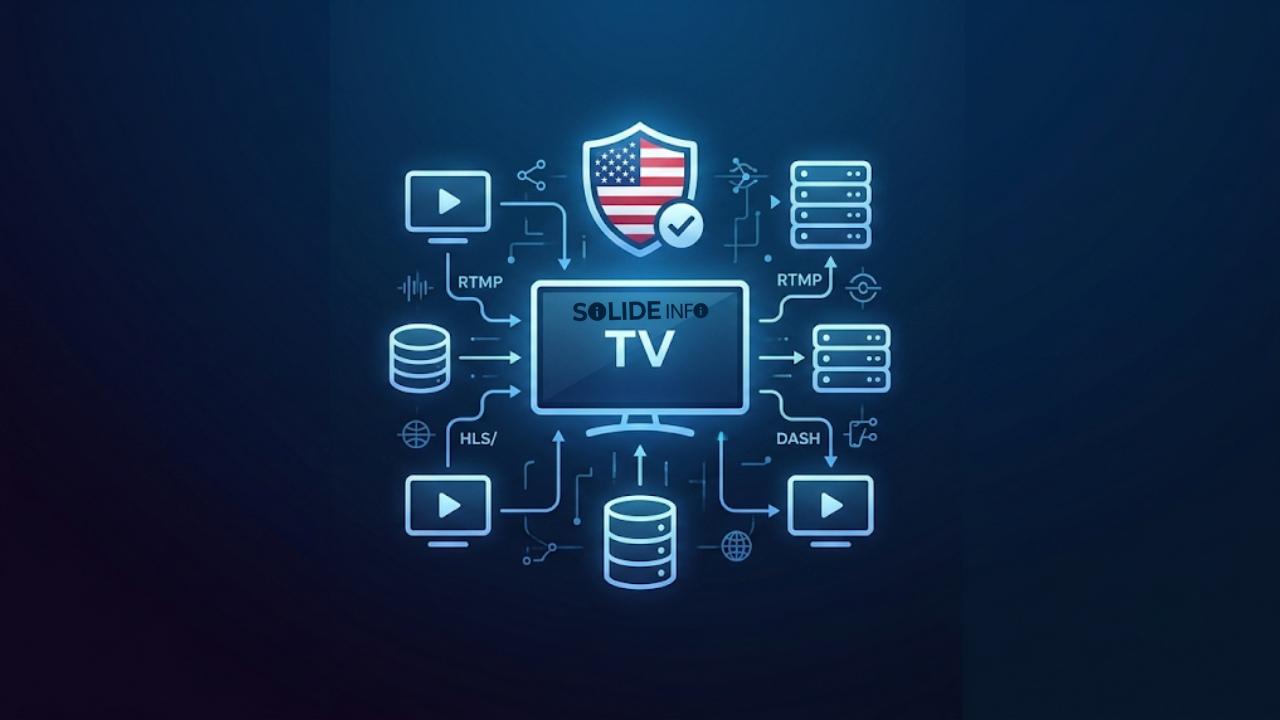
Understanding legal iptv services 4 enterprise and consumer streaming requires examining the underlying streaming protocols, content delivery networks, and legal licensing frameworks.
In modern enterprise IT environments, organizations face increasing complexity when managing hybrid infrastructure and evolving cybersecurity risks associated with media consumption.
Network administrators must distinguish between authorized vMVPD traffic and unverified streams that introduce severe network security vulnerabilities and bandwidth saturation.
This comprehensive guide breaks down the technical infrastructure powering legitimate television delivery across the United States.
We will analyze the intricate protocols, encryption standards, and network architectures that distinguish professional streaming platforms from unauthorized rogue networks.
Executive Summary
- Protocol Supremacy: Modern broadcast platforms rely heavily on Adaptive Bitrate Streaming, specifically utilizing HLS and MPEG-DASH to ensure resilient video delivery.
- Cryptographic Protection: Legitimate streaming mandates robust Digital Rights Management frameworks, deploying AES-128 encryption through Widevine, PlayReady, and FairPlay ecosystems.
- Edge Delivery Optimization: Content Delivery Networks reduce latency by caching encrypted video fragments at edge nodes situated closely to the end user.
- Enterprise Traffic Shaping: Network engineers must implement strict Quality of Service policies to prioritize UDP/TCP streaming packets, ensuring high-fidelity enterprise communications.
Technical Architecture of Legal IPTV Networks
Managing high-definition video distribution requires robust telecom infrastructure that scales dynamically while maintaining stringent security protocols across distributed nodes.
Enterprise architects must design streaming topologies that can handle massive concurrent connections without degrading the end-user viewing experience or network integrity.
Understanding Unicast vs Multicast IP Delivery in Telecom Infrastructure
Traditional terrestrial and satellite broadcasting relied on multicast distribution, where a single transmission reached millions of concurrent receivers simultaneously.
Modern legal iptv platforms utilize unicast delivery, establishing a unique one-to-one connection between the media server and each individual client device.
This unicast model requires immense bandwidth, as one million viewers necessitate one million distinct data streams traversing the network infrastructure.
To mitigate this massive load, providers deploy sophisticated Content Delivery Networks that cache media segments at decentralized edge servers geographically close to users.
This architectural shift allows network providers to deliver targeted advertising and personalized stream analytics, which multicast systems inherently lacked.
Streaming Protocols HLS MPEG-DASH and Adaptive Bitrate Delivery
Adaptive Bitrate Streaming is the foundational technology that prevents buffering by dynamically adjusting video quality based on real-time network conditions.
HTTP Live Streaming (HLS), originally developed by Apple, dominates the industry by segmenting video files into short, manageable chunks.
These chunks, typically wrapped in MPEG-2 Transport Stream (.ts) or fragmented MP4 (.m4s) formats, are indexed within an .m3u8 manifest file.
Bash
# Example: Fetching a standard HLS master playlist using curl
curl -i -H "User-Agent: Enterprise-Media-Analyzer/1.0" \
https://stream.legal-provider.local/manifest/master.m3u8
The command above simulates an enterprise monitoring tool retrieving a streaming manifest to analyze the available adaptive bitrates.
Dynamic Adaptive Streaming over HTTP (MPEG-DASH) provides an open-standard alternative, utilizing XML-based Media Presentation Description (.mpd) manifests for segment routing.
Both protocols enable the video player to seamlessly switch between 1080p, 720p, or 480p streams if the client’s bandwidth suddenly degrades.
Python
# Python snippet: Parsing an HLS m3u8 manifest for bandwidth analysis
import m3u8

def analyze_manifest(url):
    playlist = m3u8.load(url)
    for playlist_item in playlist.playlists:
        print(f"Resolution: {playlist_item.stream_info.resolution}")
        print(f"Bandwidth: {playlist_item.stream_info.bandwidth} bps")

# analyze_manifest('https://internal.media.server/stream.m3u8')
This script allows IT administrators to programmatically parse manifest files and calculate the maximum network load per client.
DRM Frameworks and Content Protection Mechanisms in Broadcast Networks
Content protection remains the primary technical differentiator between certified legal iptv providers in usa and illicit streaming syndicates.
Digital Rights Management (DRM) ensures that premium broadcast content remains encrypted during transit and can only be decrypted by authenticated clients.
The industry standardizes around three major DRM ecosystems: Google Widevine, Microsoft PlayReady, and Apple FairPlay, ensuring cross-platform device compatibility.
When a client requests a video segment, the player must concurrently fetch a decryption key from a secure DRM licensing server.
The licensing server validates the user’s session token, geographical location, and subscription tier before issuing the cryptographic key.
Evaluating Authorized Provider Ecosystems in the USA
The transition from traditional cable to digital delivery has spawned a complex ecosystem of licensed providers utilizing enterprise-grade cloud architectures.
Organizations must understand these operational models to properly secure their corporate networks against shadow IT and unauthorized media consumption.
Licensing Models and vMVPD Virtual Multichannel Video Programming Distributors
Virtual Multichannel Video Programming Distributors (vMVPDs) are platforms that deliver live television channels over the internet legally.
These platforms negotiate complex carriage agreements with broadcast networks, securing the rights to transmit copyrighted intellectual property across state lines.
Unlike unverified services, vMVPDs integrate deeply with Nielsen rating APIs and dynamic ad insertion networks to monetize their user base legally.
This legal compliance requires stringent identity verification protocols, including multi-factor authentication and continuous session monitoring across all registered endpoints.
Network Infrastructure and Content Delivery Network Edge Caching
To achieve broadcast-level reliability, best legal iptv platforms deploy highly resilient hybrid cloud architectures backed by globally distributed CDNs.
When a live event occurs, the origin server transcodes the raw feed into multiple bitrates and pushes the segments to CDN edge nodes.

This caching strategy absorbs massive traffic spikes, preventing the origin servers from collapsing under the weight of millions of simultaneous requests.
The edge nodes also handle TLS termination, ensuring that the encrypted connection overhead does not impact the core routing infrastructure.
Client-Side Security Geofencing and App-Based Streaming Authentication
Content licensing agreements are strictly bound by geographical borders, necessitating robust geofencing and client-side validation mechanisms.
Legal streaming platforms utilize a combination of IP geolocation databases, GPS coordinates from mobile devices, and Wi-Fi triangulation to enforce regional blackouts.
If a user attempts to bypass these restrictions using a proxy or VPN, advanced deep packet inspection algorithms often detect the obfuscation.
Once anomalous routing is detected, the authentication API instantly revokes the session token, terminating the stream to maintain strict copyright compliance.
Technical Implementation and Home Network Optimization
Achieving enterprise-grade streaming performance requires meticulous configuration of local network topologies, focusing on latency reduction and packet prioritization.
Network engineers must implement advanced traffic shaping policies to guarantee that encrypted video payloads arrive without jitter or packet loss.
Quality of Service Configuration for Low-Latency IPTV Streams
Quality of Service (QoS) protocols are essential for maintaining the integrity of continuous video streams on congested corporate or home networks.
By utilizing Differentiated Services Code Point (DSCP) values, administrators can prioritize time-sensitive media packets over bulk background data transfers.
Plaintext
# Cisco IOS QoS configuration snippet for streaming media prioritization
class-map match-any LEGAL-IPTV-TRAFFIC
 match protocol http-video
 match dscp af41
!
policy-map PRIORITY-STREAMING
 class LEGAL-IPTV-TRAFFIC
  bandwidth percent 40
  queue-limit 64 packets
 class class-default
  fair-queue
This configuration snippet demonstrates how network architects allocate guaranteed bandwidth to authorized video streams, preventing buffer starvation during peak utilization.
Proper QoS implementation ensures that low-latency HLS (LL-HLS) streams can achieve sub-two-second delays, rivaling traditional broadcast television latency.
Network Packet Analysis and Advanced Traffic Shaping
To baseline streaming performance, network security teams frequently capture and analyze incoming media streams using packet sniffer utilities.
Analyzing the TCP window size and Round Trip Time (RTT) helps identify peering bottlenecks between the ISP and the CDN edge.
Bash
# Bash snippet: Capturing streaming traffic for network analysis
# Note: Run with appropriate administrative privileges
tcpdump -i eth0 -n -s 0 port 443 -w stream_capture.pcap &
sleep 60
kill $!
This command captures encrypted HTTPS traffic for exactly sixty seconds, allowing engineers to analyze TLS handshakes and CDN routing paths.
Through careful packet analysis, administrators can adjust Maximum Transmission Unit (MTU) sizes to prevent packet fragmentation, which degrades streaming efficiency.
Anonymized Technical Demonstration Analyzing HLS Stream Manifests via CLI
Understanding the mechanics of chunk delivery requires a deep dive into the manifest structures that govern adaptive bitrate transitions.
By inspecting the EXT-X-STREAM-INF tags, developers can map the exact resolution boundaries and codec requirements of the provider.

The manifest also dictates the encryption methodology, pointing the player to the specific Key Management Server (KMS) handling the DRM exchange.
This transparent, standard-based approach highlights the stark contrast between engineered legal iptv architectures and poorly constructed pirated networks.
Enterprise Tools vs Open Source Solutions in Media Streaming
Organizations building internal broadcasting platforms must choose between proprietary enterprise streaming solutions and flexible open-source media servers.
This decision impacts scalability, licensing costs, and the level of technical expertise required to maintain the distribution infrastructure.
Commercial Streaming Platforms vs Open Source Video Delivery
Commercial platforms like Wowza or enterprise cloud services provide turnkey solutions featuring integrated DRM, dynamic packaging, and global CDN partnerships.
These enterprise tools offer dedicated support SLA agreements, ensuring rapid incident response when high-profile corporate broadcasts encounter delivery failures.
Conversely, open-source solutions like Nginx with the RTMP module offer unparalleled customization for engineers willing to build the architecture manually.
While open-source tools eliminate licensing fees, they shift the burden of maintaining security patches and DRM integrations entirely onto the internal IT team.
Enterprise Cloud Architecture for Scalable Broadcasting
Modern enterprise broadcasting leverages cloud-native architectures, utilizing containerized microservices to scale transcoding nodes dynamically based on viewer demand.
Kubernetes clusters can spin up additional FFmpeg encoding pods automatically when an internal town hall event requires multiple adaptive bitrate renditions.
This elasticity prevents infrastructure bottlenecks, ensuring that every employee receives a flawless stream regardless of their remote working location.
Cloud environments also provide integrated analytics, giving IT leaders granular visibility into viewing metrics, buffering events, and client device distributions.
Operational Challenges and Best Practices for Network Administrators
Deploying and maintaining secure video delivery networks introduces unique operational hurdles that demand proactive monitoring and stringent security configurations.
IT leaders must balance the need for high-quality video communication with the absolute necessity of protecting corporate bandwidth and data integrity.
Managing Bandwidth Saturation in High-Density Environments
The primary challenge of widespread video consumption is network saturation, particularly in dense office environments sharing a single WAN uplink.
When hundreds of employees stream high-definition content concurrently, the localized network can experience severe packet loss and degraded VOIP performance.
To mitigate this, administrators deploy Enterprise Content Delivery Networks (eCDN) that utilize peer-to-peer sharing or local caching servers within the corporate LAN.
These localized caches download the video segment once from the external CDN and distribute it internally, drastically reducing the external bandwidth footprint.
Implementing Zero Trust Network Access for Streaming Media
Zero Trust architectures dictate that no traffic should be inherently trusted, regardless of whether it originates from inside or outside the corporate perimeter.
Network security teams must inspect all iptv legal providers traversing the network, ensuring the streams are not masking data exfiltration attempts.

Access to internal streaming portals should be governed by strict Identity and Access Management (IAM) policies, requiring multi-factor authentication for every session.
By applying Zero Trust principles, organizations ensure that their media delivery infrastructure remains resilient against unauthorized access and lateral movement attacks.
Advanced FAQ Section
How does legitimate video distribution impact enterprise IT strategy?
Enterprise IT strategy must account for the massive bandwidth requirements and security implications of modern streaming. IT leaders should implement eCDN solutions, robust QoS policies, and Zero Trust gateways to ensure video traffic does not compromise critical business operations or network integrity.
What are the main implementation challenges for secure streaming architectures?
The primary challenges include managing DRM key exchanges securely, overcoming latency issues inherent to HTTP-based delivery, and scaling the transcoding infrastructure dynamically. Additionally, balancing high-definition video delivery with strict corporate firewall policies requires precise network engineering and continuous traffic analysis.
What should IT leaders consider before adopting internal broadcasting tools?
Leaders must evaluate the platform’s support for adaptive bitrate protocols, its integration with existing Identity Providers (IdP), and compliance with enterprise data privacy standards. They should also assess whether to build an open-source architecture or invest in a commercial solution backed by guaranteed service level agreements.
How do network engineers distinguish authorized streams from shadow IT?
Engineers utilize Deep Packet Inspection (DPI) and layer-7 firewalls to analyze HTTPS traffic signatures and server name indications (SNI). By comparing traffic patterns against known manifests and authorized CDN endpoints, administrators can quickly block unverified media consumption while prioritizing approved corporate video platforms.
Relying strictly on certified legal iptv services 4 enterprise needs guarantees enterprise-grade uptime, high-definition streaming protocols, and full compliance with content licensing laws.
Discover more from Solide Info | The Engineer’s Authority on Cyber Defense
Subscribe to get the latest posts sent to your email.