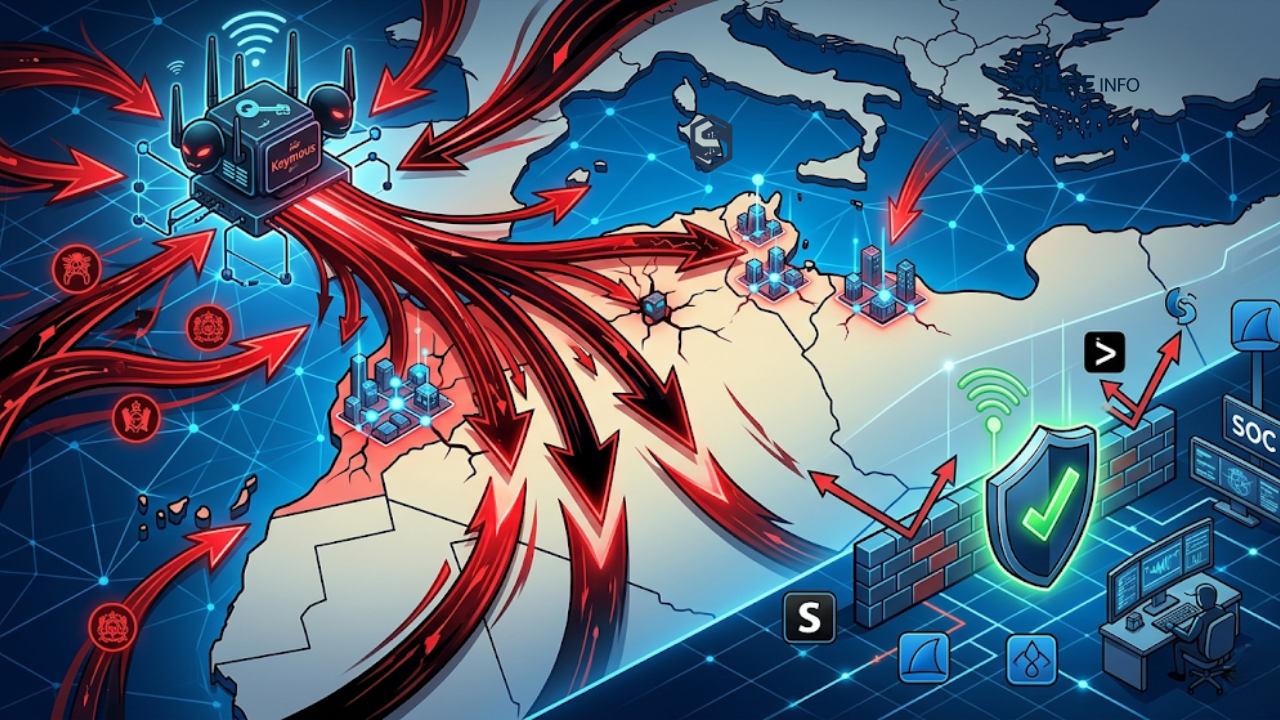
The emergence of Keymous plus as a specialized tool for high-intensity traffic generation has fundamentally altered the threat landscape for North African regional infrastructure.
In the contemporary cybersecurity environment, the distinction between state-sponsored actors and localized hacktivist collectives is increasingly blurred.
Enterprise networks, once only concerned with sophisticated data exfiltration, now face the brute-force reality of massive traffic saturation.
This article dissects the technical architecture of these threats, focusing on the tools, the actors, and the defensive posture required to survive them.
Executive Summary
- Core Threat: Keymous plus (also known as Keymous+) represents a modernized iteration of DDoS-as-a-Service tools, capable of orchestrating massive volumetric surges.
- Primary Actors: Operations are frequently attributed to a North African hacktivist group targeting government, financial, and telecommunications sectors.
- Technical Vector: The tool leverages amplification techniques (DNS, NTP, and Memcached) alongside Layer 7 application-specific exhaustion.
- Enterprise Impact: Beyond mere downtime, these attacks serve as “smokescreens” for secondary intrusions or as tools for geopolitical influence.
The Technical Architecture of Keymous plus and Volumetric DDoS
Volumetric DDoS attacks are designed to consume the bandwidth of the target site or the intermediate infrastructure (routers, firewalls, and ISP uplinks).
Unlike protocol attacks that target state tables, volumetric attacks aim to saturate the “pipe” itself.
Keymous plus has gained notoriety for its efficiency in coordinating distributed nodes to achieve this saturation with minimal resource expenditure from the attacker’s perspective.
Anatomy of a Keymous+ Attack Vector
The architecture of a Keymous plus campaign typically follows a multi-stage process.
First, the controller identifies a set of vulnerable reflectors—publicly accessible servers that respond to small requests with disproportionately large responses.
This amplification factor is the secret sauce behind the tool’s effectiveness.
For instance, a DNS amplification attack can have a factor of 50x, meaning a 1Gbps stream from the botnet can become a 50Gbps flood at the target’s doorstep.
The tool uses a modular design, allowing the operator to switch between UDP-based reflection and TCP-based SYN floods depending on the target’s defensive configuration.
In a SYN flood scenario, the tool sends a barrage of “Synchronize” packets with spoofed IP addresses, forcing the target’s server to keep connections half-open, eventually exhausting the SYN queue.
Exploiting L4 and L7 Vulnerabilities
While Layer 4 (Transport Layer) attacks are the bread and butter of Keymous plus, its “plus” iteration includes enhanced Layer 7 (Application Layer) capabilities.
L7 attacks are more insidious because they mimic legitimate user behavior.
The tool can generate thousands of HTTP GET or POST requests per second directed at resource-intensive endpoints, such as search queries or PDF generation scripts.
This forces the application server’s CPU and memory into exhaustion without necessarily saturating the network bandwidth.
Modern North African hacktivist groups use this hybrid approach—hitting the network with a volumetric hammer while simultaneously using an L7 scalpel to disable specific services.
# Example of a simplified Python-based monitoring script to detect
# anomalous traffic spikes potentially related to Keymous+ signatures.
# This script monitors packet counts per second (PPS) on a specific interface.

import time
import psutil

def monitor_traffic(interface='eth0', threshold=100000):
    print(f"Monitoring {interface} for volumetric anomalies...")
    last_stats = psutil.net_io_counters(pernic=True)[interface]

    while True:
        time.sleep(1)
        current_stats = psutil.net_io_counters(pernic=True)[interface]

        # Calculate packets per second
        pps_in = current_stats.packets_recv - last_stats.packets_recv

        if pps_in > threshold:
            print(f"[ALERT] Potential Volumetric Attack: {pps_in} PPS detected!")
            # Triggering an automated BGP Flowspec or API call to a scrubbing center
            # trigger_mitigation(pps_in)

        last_stats = current_stats

# monitor_traffic()
Technical Workflow of a Keymous plus Attack
The following diagram illustrates the workflow from the command-and-control (C2) server to the target infrastructure.

Regional Threat Actors and the North African Hacktivist Context
The geopolitical landscape of North Africa provides a fertile ground for hacktivism.
Groups operating in this region often align their targets with social, political, or religious movements.
The use of Keymous plus by these groups is not accidental; it is a choice driven by the tool’s accessibility and its ability to inflict high-profile damage with relatively low technical overhead.
The Rise of Politically Motivated Volumetric Attacks
Historically, hacktivism was limited to website defacements or “doxing.”
However, as regional conflicts move into the digital sphere, the objective has shifted toward economic and social disruption.
A North African hacktivist group might target a national bank’s online portal during a period of civil unrest to undermine public confidence in the financial system.
In these contexts, the volumetric attack is a statement of power.
The availability of leaked or cracked versions of Keymous plus on Telegram channels and underground forums has democratized this capability.
What was once the domain of state-sponsored APTs is now available to anyone with a few hundred dollars or the right connections within the regional hacktivist community.
Operational Patterns of the North African Hacktivist Group
These groups typically operate with a high degree of transparency on social media, announcing “operations” beforehand to build momentum.
This provides a window for IT professionals to prepare, but the sheer volume of Keymous+ traffic can often overwhelm standard on-premise defenses.
Their modus operandi involves:
- Reconnaissance: Identifying targets with weak DDoS protection (e.g., those not behind a CDN).
- Tool Deployment: Provisioning VPS (Virtual Private Servers) in jurisdictions with lax anti-spoofing policies.
- The Surge: Launching the attack in waves, often coinciding with peak business hours in the target’s time zone.
- Amplification via Media: Using the downtime to gain headlines, thereby increasing the perceived impact of the attack.
Operational Lifecycle Diagram
This diagram explains the operational cycle of a hacktivist campaign utilizing volumetric tools.

Enterprise Mitigation Strategies and Defensive Frameworks
Defending against Keymous plus requires a shift from a “reactive” posture to a “resilient” architecture.
Standard firewalls are often the first casualty of a volumetric attack, as their state tables fill up instantly.
Modern defense must happen at the edge, ideally before the traffic even reaches the enterprise’s local ISP connection.
Multi-Layered DDoS Defense Architecture
An effective defense is built on three pillars: Detection, Diversion, and Mitigation.
- Cloud-Native Protection: Utilizing services like AWS Shield, Google Cloud Armor, or Cloudflare is essential. These providers have the aggregate bandwidth (measured in Terabits per second) to absorb the massive floods generated by North African hacktivist groups.
- Anycast Routing: By using Anycast, an enterprise can distribute incoming traffic across multiple global data centers. This prevents any single point of entry from being overwhelmed, as the attack traffic is “diluted” across the provider’s entire network.
- BGP Flowspec (RFC 5575): This allows network engineers to propagate traffic filtering rules across their ISP’s infrastructure. Instead of dropping all traffic to a targeted IP (Blackholing), Flowspec allows for granular filtering of specific protocols or packet lengths associated with Keymous plus signatures.
Incident Response and Traffic Scrubbing Workflows
When an attack is detected, the traffic must be rerouted to a “Scrubbing Center.”
These are specialized facilities equipped with high-performance hardware capable of inspecting packets at line rate and stripping away malicious traffic while allowing legitimate users to pass through.
The transition to a scrubbing center can be manual (via DNS change or BGP announcement) or automated (via always-on solutions).
For organizations targeting the North African market, it is critical to ensure that the scrubbing center has a Point of Presence (PoP) in or near the region to minimize latency for legitimate users.
Mitigation Architecture Overview
The following diagram illustrates how an enterprise should structure its defense against volumetric threats.

Implementing Local Protections (Example)
While edge protection is primary, local server hardening can provide a last line of defense against smaller-scale L7 attacks or residual noise.
# Example of using iptables to limit SYN packet rates on a Linux server.
# This helps mitigate smaller SYN floods that might bypass edge filters.

# Create a new chain for SYN flood protection
iptables -N SYN_FLOOD

# Limit SYN packets to 20 per second, allowing bursts of up to 50
iptables -A SYN_FLOOD -p tcp --syn -m limit --limit 20/s --limit-burst 50 -j RETURN
iptables -A SYN_FLOOD -j DROP

# Jump to the SYN_FLOOD chain for all incoming TCP SYN packets
iptables -A INPUT -p tcp --syn -j SYN_FLOOD

# Example of increasing the SYN backlog queue for high-traffic environments
sysctl -w net.ipv4.tcp_max_syn_backlog=4096
sysctl -w net.ipv4.tcp_syncookies=1
Future Trends in DDoS-as-a-Service and Automated Threats
The evolution of Keymous plus is a precursor to a more automated and intelligent threat landscape.
As we look toward the next decade, several trends emerge that will challenge current defensive paradigms.
AI-Driven Botnets and the Next Generation of Keymous+
We are beginning to see the integration of machine learning into attack tools.
Future versions of DDoS software may be able to analyze a target’s mitigation response in real-time and automatically adjust its attack vectors.
If a scrubbing center successfully blocks a UDP reflection, the tool could autonomously switch to an HTTPS “Rapid Reset” attack (as seen in the HTTP/2 vulnerability exploits).
Furthermore, the rise of the Internet of Things (IoT) provides an inexhaustible supply of poorly secured devices for North African hacktivist groups to recruit into their botnets.
A “Keymous+ IoT” variant could potentially orchestrate attacks from millions of cameras, DVRs, and smart home devices, creating traffic volumes that were previously unimaginable.
The Professionalization of Regional Hacktivism
The hacktivist collective of the future is likely to be better funded and more technically adept.
We are seeing a trend toward “Cyber-Mercenarism,” where political groups hire professional DDoS providers to conduct campaigns.
This professionalization means that the tools used, like Keymous plus, will be refined for maximum impact and stealth.
Defenders must therefore invest in behavioral analysis and zero-trust architectures to ensure that even if a volumetric attack is underway, the internal network remains secure and operational.
Best Practices for Network Resilience
To counter the threat of Keymous plus and its users, enterprise IT managers must adopt a holistic approach to network resilience.
This goes beyond just buying a tool; it involves people, processes, and technology.
Hardening Edge Infrastructure
- Disable Unnecessary Services: Ensure that your network does not inadvertently act as a reflector. Disable or secure DNS, NTP, and SNMP on all public-facing interfaces.
- Ingress/Egress Filtering: Implement BCP 38 (Network Ingress Filtering) to prevent spoofed IP addresses from leaving your network. This helps the global community by reducing the pool of usable attack nodes.
- Redundant Connectivity: Use diverse ISP paths and BGP multi-homing. This ensures that even if one provider’s link is saturated, you have alternative paths for traffic.
- Regular Stress Testing: Conduct “Red Team” DDoS simulations. You cannot know how your infrastructure will react to a 500Gbps Keymous+ flood until you simulate it in a controlled environment.
Monitoring and Alerting
Real-time visibility is the cornerstone of DDoS defense.
IT teams should implement NetFlow/SFlow monitoring to gain deep insights into traffic patterns.
By establishing a baseline of “normal” traffic, anomalies can be detected within seconds of an attack starting.
This early detection is critical for minimizing the “Time to Mitigate” (TTM).
FAQ Section
Q1: How does Keymous plus differ from older tools like LOIC or HOIC?
A: Unlike the Low Orbit Ion Cannon (LOIC), which relied on voluntary participation and simple packet flooding, Keymous plus is a sophisticated, multi-vector tool. It automates reflection and amplification techniques, making it far more powerful per bot. It also includes advanced Layer 7 bypass mechanisms designed to evade traditional WAF signatures.
Q2: Can a standard enterprise firewall stop a 100Gbps volumetric attack?
A: Generally, no. Most enterprise firewalls, even high-end models, are limited by their physical interface speeds (e.g., 10Gbps or 40Gbps) and their session state table capacity. A 100Gbps attack will saturate the ISP link before it even reaches the firewall, and the firewall itself will likely crash trying to process the massive packet-per-second (PPS) load. Cloud-based mitigation is the only viable solution for such volumes.
Q3: Why are North African hacktivist groups specifically mentioned in relation to this tool?
A: Regional monitoring by cybersecurity firms has identified a high concentration of Keymous+ activity emanating from and targeting the North African region. This is attributed to the tool’s popularity in regional underground forums and its alignment with the tactical needs of local hacktivist collectives who prioritize high-visibility, disruptive attacks.
Q4: What is the significance of the “plus” in the tool’s name?
A: In the world of malware and attack tools, “plus” usually denotes a version that has been upgraded with new features—often including EDR (Endpoint Detection and Response) bypass, improved C2 encryption, more amplification vectors, and better stability. For Keymous+, it specifically points to the enhanced Application Layer attack capabilities.
Q5: Is it possible to trace the origin of a Keymous+ attack?
A: It is extremely difficult. Because the tool primarily uses spoofed UDP packets and reflection through legitimate third-party servers, the “source” IP addresses in the logs are those of innocent reflectors (like Google’s DNS or university NTP servers). Identifying the actual controller requires deep forensic analysis of the botnet nodes and C2 infrastructure, which often spans multiple global jurisdictions.
Q6: How does BGP Flowspec help in mitigating these attacks?
A: BGP Flowspec allows a network operator to send a rule to their upstream ISP’s routers. For example, if a Keymous+ attack is identified as coming from UDP port 123 (NTP) with a packet length of 400 bytes, the operator can use Flowspec to tell the ISP’s routers to drop only those specific packets. This “cleans” the traffic at the provider level, ensuring only legitimate traffic reaches the enterprise.
Q7: Should we pay a ransom to a hacktivist group to stop a DDoS attack?
A: No. Cybersecurity experts and law enforcement agencies (such as the FBI and Interpol) strongly advise against paying ransoms. Payment provides no guarantee that the attack will stop, and it directly funds the development of more advanced tools like Keymous plus. Furthermore, it marks the organization as a “payer,” likely leading to more frequent attacks in the future.
Q8: Can a WAF protect against Layer 4 volumetric attacks?
A: A Web Application Firewall (WAF) is designed for Layer 7 (HTTP/HTTPS) traffic. While some advanced WAFs are integrated with DDoS mitigation platforms, a standalone WAF is not the correct tool for stopping a Layer 4 SYN flood or UDP reflection. You need a dedicated DDoS mitigation layer or a scrubbing service to handle transport-layer saturation.
The threat posed by Keymous plus is a stark reminder that the fundamentals of network security—bandwidth, protocol integrity, and edge defense—are as critical today as they were two decades ago.
While the North African hacktivist group landscape continues to evolve, their reliance on volumetric disruption remains a constant.
By understanding the technical nuances of amplification attacks and implementing a robust, multi-layered defense strategy, enterprise organizations can ensure their digital infrastructure remains resilient.
The goal is not just to survive an attack, but to render it ineffective through superior architecture and proactive management.
Ultimately, neutralizing the persistent threat posed by Keymous plus requires a global perspective on local threats.
Discover more from Solide Info | The Engineer’s Authority on Cyber Defense
Subscribe to get the latest posts sent to your email.