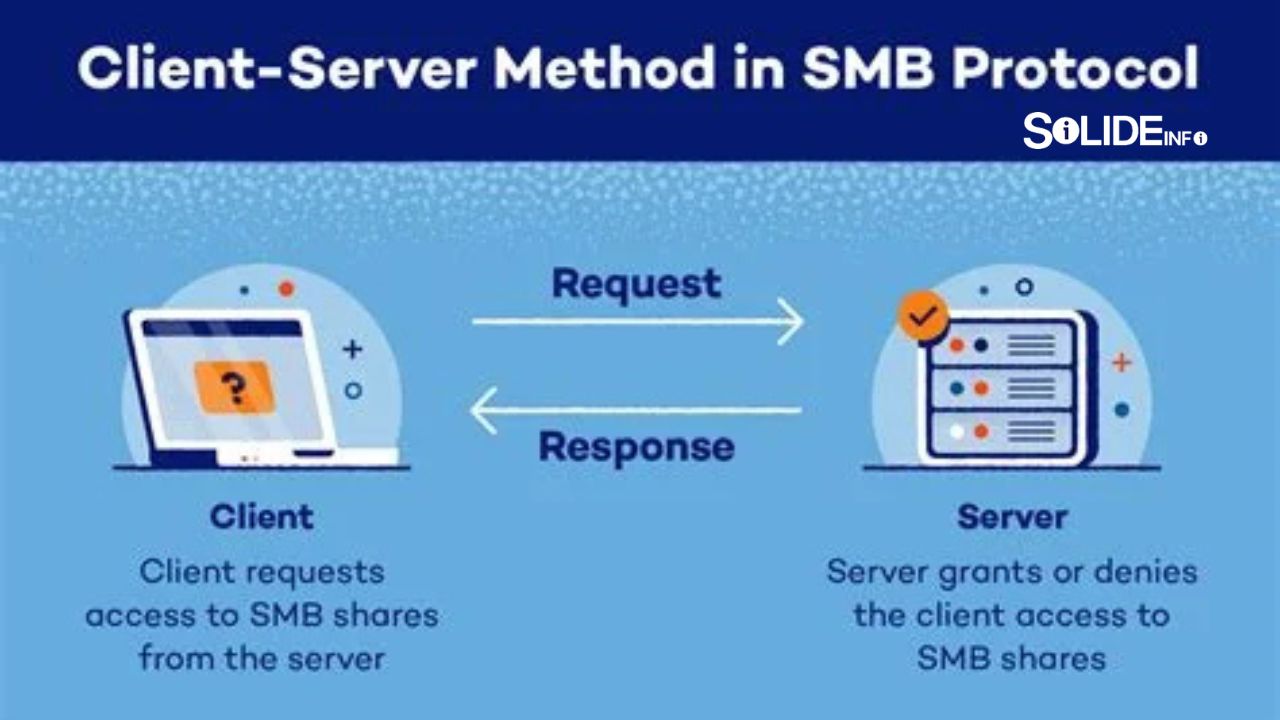
Server Message Block (SMB) is the built-in Windows protocol that allows one computer to communicate with another across a network for shared resources and control traffic. Most people first encounter it through file sharing, like opening a shared folder, mapped drive, or network printer.
However, SMB does much more than move files. It is also used for named-pipe communication, administrative shares (such as C$ and IPC$), service-control traffic, and other host-to-host hand-offs.
In simple terms, it acts as Windows’ internal communication highway. It allows systems on the same reachable network to exchange data and commands. This is why it is so critical in threat modeling: once trust boundaries weaken, SMB becomes a primary pathway for lateral movement.
Beyond File Sharing: SMB as a Trusted Movement Layer
SMB is dangerous in a threat model because it is not just “file sharing.” In a real intrusion, it becomes a trusted internal movement layer. Once an attacker gains a foothold on one machine, SMB helps them move quietly across the environment.
It can carry file transfers, named-pipe traffic, service-control hand-offs, and remote session communication. In practical terms, this means it may be used to stage files, hand off scripts or services, and communicate through administrative shares like IPC$ and C$.
The real risk comes down to trust boundaries and reachability. If guest access, null sessions, or over-permissive policies exist, SMB becomes a low-friction path for service hand-off. It often becomes the movement layer once a single host is compromised.
The Attacker Opportunity Chain: Scaling the Breach
The cleanest way to threat-model SMB is to treat it as a chain of attacker opportunities. This explains why SMB shows up repeatedly in ransomware campaigns and CISA/FBI advisories. The chain typically follows five stages:
- Reachability: Can one machine talk to another over port 445 at all?
- Identity: Can the attacker authenticate with a password, NTLM material, or Kerberos tickets?
- Authorization: Once connected, can they reach admin shares or writable folders?
- Execution: Can they convert access into code execution via services or remote tasks?
- Blast Radius: How many systems are “flat” enough for this move to work repeatedly?
This chain is the difference between one infected laptop and domain-wide encryption by morning. Ransomware impact is magnified by internal segmentation weaknesses, not just the initial breach.
Modern Ransomware: SMB as a Force Multiplier
Modern ransomware uses SMB as a force multiplier. Instead of relying solely on wormable exploits, operators get in through phishing or stolen credentials and then use SMB for the internal expansion phase.
The Black Basta advisory notes that affiliates use PsExec and BITSAdmin for lateral movement. PsExec matters here because it rides on SMB and administrative shares under the hood. Even when an advisory names a tool, SMB is often the transport.
The same pattern shows up with LockBit. Affiliates use common Windows admin pathways for deployment at scale. It turns a quiet foothold into broad deployment. Without an internal admin channel like SMB, many ransomware operators slow down dramatically.
Detection and Forensics: Indicators of SMB Compromise
There are specific signs that SMB or host-to-host movement has been compromised. The key is to look for behavioral patterns rather than the existence of the protocol itself.
One of the biggest signs is the unexpected use of administrative shares like \ADMIN$ or \C$. On Windows systems, this often shows up as Event IDs 5140 or 5145, especially when touched by non-admin users.
Another major sign is network logons (Logon Type 3) and explicit credential use (Event ID 4648). These are suspicious if the same account logs into multiple hosts in a short time window. You should also watch for service creation (Event ID 7045) and tools like psexesvc.exe.
Finally, watch for “port 445 fan-out.” If one machine suddenly makes repeated connections to several internal IPs on port 445, it is a sign of scanning or propagation. Those are the strongest indicators of an SMB-based intrusion.
Discover more from Solide Info | The Engineer’s Authority on Cyber Defense
Subscribe to get the latest posts sent to your email.