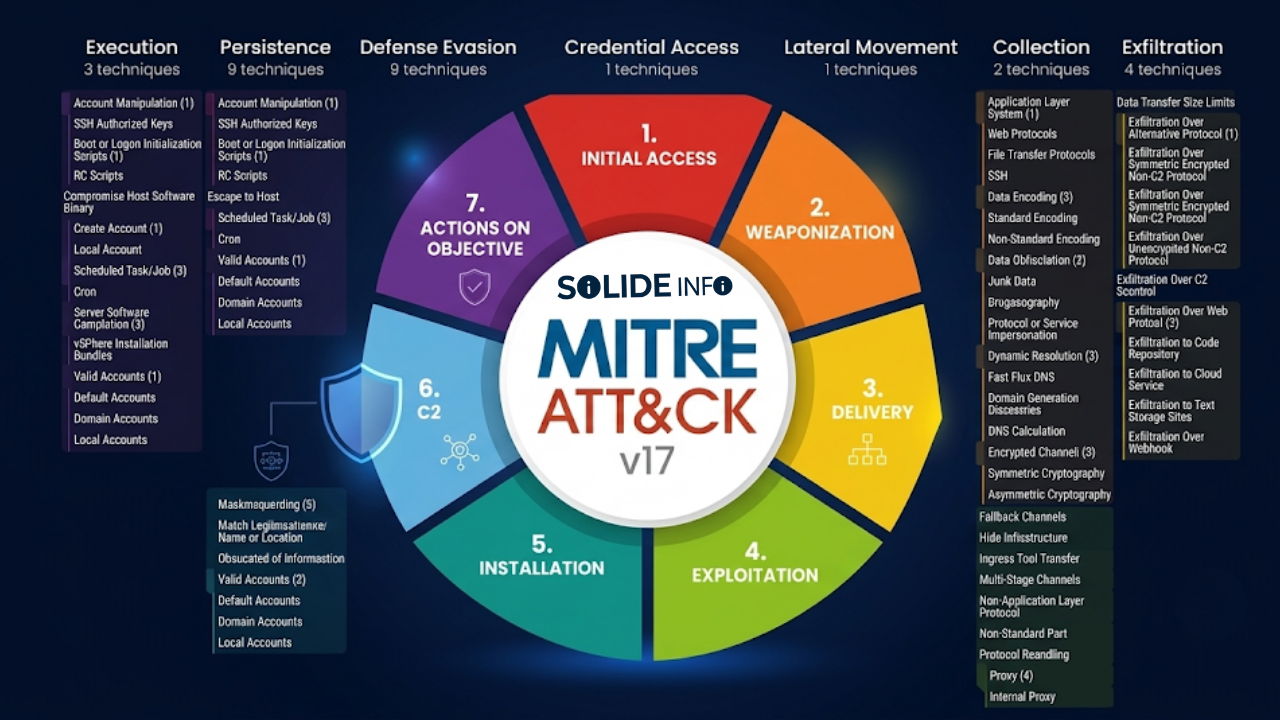
- The mitre attack framework gives security teams a shared, adversary-based language for describing tactics, techniques, and procedures (TTPs) instead of relying on fragmented, vendor-specific threat labels.
- Mapping detections, log sources, and SOC playbooks to ATT&CK techniques exposes real visibility gaps that traditional compliance checklists routinely miss.
- Combining ATT&CK with the cyber kill chain and structured threat modeling turns adversary emulation into a repeatable, measurable engineering discipline rather than a one-off exercise.
- Security automation — from SIEM correlation rules to SOAR playbooks — becomes dramatically more maintainable once every rule is tagged to a specific technique ID.
In modern cybersecurity environments, adopting the mitre attack framework allows security operations teams to systematically analyze, detect, and mitigate complex adversary tactics across enterprise networks. Most organizations already own detection tools; what they lack is a common taxonomy that connects those tools to real adversary behavior.
This gap is exactly what the mitre attack framework was built to close. It replaces ad-hoc threat labeling with a structured matrix of tactics and techniques drawn from observed intrusions, giving CISOs, SOC analysts, and architects a shared reference point.
This article walks through the foundations of the framework, how it integrates into enterprise infrastructure, real implementation patterns, and the operational challenges teams encounter when rolling it out at scale.
For technology leaders evaluating where to invest scarce security budget, the value of this framework lies less in the matrix itself and more in the discipline it forces across the organization: every detection, every playbook, and every architecture decision can be traced back to a documented, real-world adversary behavior rather than an assumption about what attackers might do.
Understanding the Foundations of the MITRE ATT&CK Framework
ATT&CK stands for Adversarial Tactics, Techniques, and Common Knowledge. It organizes adversary behavior into tactics — the “why” of an action — and techniques, the “how.”
Each tactic column (Initial Access, Execution, Persistence, Privilege Escalation, Defense Evasion, Credential Access, Discovery, Lateral Movement, Collection, Command and Control, Exfiltration, Impact) contains multiple techniques and sub-techniques, each carrying a unique identifier such as T1059 or T1003.001.
Tactics vs Techniques vs Procedures
Tactics describe adversary goals; techniques describe the method used to achieve that goal; procedures describe the specific implementation observed in the wild, often tied to a named threat actor or malware family.
This three-layer model matters because it lets defenders reason at different altitudes depending on the audience. A CISO briefing the board cares about tactics — “the attacker attempted to escalate privileges.” A detection engineer writing a rule cares about the specific technique and sub-technique. A threat intelligence analyst tracking a specific actor cares about the exact procedure, down to the command-line syntax observed.
Sub-techniques add a further layer of precision beneath many techniques. Credential Access, for instance, includes sub-techniques covering OS credential dumping from LSASS memory, from the Security Account Manager database, and from cached domain credentials, each requiring a different detection approach even though they share the same parent technique and the same broad adversary goal.
The Enterprise, Mobile, and ICS Matrices
MITRE maintains separate matrices for enterprise IT, mobile platforms, and industrial control systems, which matters when an organization’s attack surface spans cloud workloads, endpoints, and operational technology simultaneously.
The enterprise matrix itself is further broken down by platform, including Windows, macOS, Linux, network devices, containers, SaaS, IaaS, Office 365, Azure AD, and Google Workspace. This granularity reflects how differently the same tactic can manifest depending on the underlying platform — Persistence on a Linux server looks nothing like Persistence in a SaaS identity tenant.
Organizations running converged IT and operational technology environments, such as manufacturers or utilities, increasingly reference the ICS matrix alongside the enterprise matrix, since an intrusion that begins on the corporate network can pivot into control-system territory through poorly segmented historian servers or engineering workstations.
The framework is not static, either. MITRE releases updates multiple times per year, adding new techniques, retiring or merging outdated ones, and refining sub-technique definitions based on new intrusion research contributed by the broader security community.
This continuous evolution means that a coverage mapping completed eighteen months ago is very likely out of date today, not because the organization’s environment changed, but because the framework itself has grown more precise in describing adversary behavior that was previously bundled under broader, less actionable categories.
Relationship to the Cyber Kill Chain and Why a Common Taxonomy Matters
The cyber kill chain describes a linear intrusion sequence from reconnaissance to actions on objectives. ATT&CK is more granular and non-linear, which is why many mature SOCs use the kill chain for executive reporting and ATT&CK for technical detection engineering.
An intrusion rarely moves through these stages in a straight line. Adversaries loop back to Discovery after gaining a new foothold, re-attempt Credential Access after a failed escalation, and often run Collection and Command and Control activity in parallel rather than sequentially. This is precisely why a purely linear model like the kill chain, while useful for storytelling, cannot drive detection engineering on its own.
Before frameworks like ATT&CK became standard, security teams described the same adversary behavior in inconsistent ways across vendors, reports, and internal documentation. One analyst might call an activity “lateral movement,” another might call it “internal reconnaissance,” with neither description wrong but neither comparable either.
A shared taxonomy solves this by giving every technique a stable identifier that survives tool changes, staff turnover, and vendor migrations, and this consistency becomes especially valuable during incident response, when multiple teams need to communicate quickly and precisely under time pressure.
How the Framework Fits Into Modern IT and Enterprise Infrastructure
Enterprise environments rarely consist of a single, uniform network. They span on-premise data centers, multiple cloud providers, SaaS platforms, and remote endpoints, each generating different telemetry.
The mitre attack framework provides a consistent way to describe adversary behavior regardless of which layer of that hybrid stack is involved, which is essential for teams trying to unify detection coverage.
Cloud, Hybrid Architecture, and Security Framework Alignment
Cloud-focused techniques — such as abusing valid cloud accounts or exploiting misconfigured IAM roles — map directly to ATT&CK’s cloud matrix, letting security architects validate that CSPM and CIEM tooling actually covers documented adversary behavior rather than generic misconfiguration rules.
Many organizations also layer ATT&CK on top of existing frameworks like NIST CSF or ISO 27001. It doesn’t replace governance frameworks; it operationalizes their “detect” and “respond” functions with concrete, technique-level detail.
Networking, SOC Visibility, and DevOps Pipelines
Network segmentation, east-west traffic inspection, and DNS logging all map to specific ATT&CK techniques under Discovery and Lateral Movement, helping network architects justify segmentation investments with adversary-behavior evidence instead of abstract risk statements.
Flat networks are a recurring finding in ATT&CK-driven assessments. Once an adversary establishes a foothold, techniques like Remote Services or Exploitation of Remote Services become trivial to execute when internal traffic is not segmented or inspected, giving infrastructure teams concrete justification for microsegmentation.
Modern enterprises also provision infrastructure through code, and this shift carries its own relevant techniques, particularly around Valid Accounts and Supply Chain Compromise within CI/CD pipelines. A compromised pipeline credential or a poisoned dependency can grant an adversary a path to production that bypasses traditional network and endpoint controls entirely.
Identity and Access Management Alignment
A growing share of enterprise intrusions now begin with valid, stolen credentials rather than exploited software vulnerabilities. ATT&CK’s Initial Access and Credential Access tactics reflect this shift directly.
Techniques such as password spraying, MFA fatigue attacks, and abuse of federated identity trust relationships all have dedicated ATT&CK entries, which helps identity teams prioritize conditional access policies and privileged access management investments around documented adversary behavior rather than generic best practice.
For enterprises running hybrid identity — synchronizing on-premise directory services with a cloud identity provider — this mapping is particularly important, since a compromise of the synchronization layer can grant an adversary a path between environments that neither team fully owns on its own.
Detection engineers covering this space typically map monitoring around techniques such as Steal or Forge Authentication Certificates, Application Access Token abuse, and manipulation of federation trust configuration, since these give an adversary a persistent path between on-premise and cloud identity planes that is often invisible to teams monitoring each environment separately.
Privileged access management adds another layer here. Techniques under Privilege Escalation frequently target service accounts, break-glass credentials, and standing administrative access rather than individual user accounts, which is why just-in-time access models and regular privileged account reviews consistently appear as compensating controls in ATT&CK-informed architecture reviews.
Modern enterprises increasingly provision infrastructure through code rather than manual configuration too, and this shift has its own set of relevant techniques, particularly around Valid Accounts and Supply Chain Compromise within CI/CD pipelines. A compromised pipeline credential or a poisoned dependency can grant an adversary a path to production that bypasses traditional network and endpoint controls entirely.
Below is a simplified view of how telemetry sources feed into an ATT&CK-mapped detection pipeline.

Real-World Applications and Technical Use Cases
Organizations use the mitre attack framework in several concrete, repeatable ways rather than as a purely academic reference document.
Detection Engineering and Rule Tagging
Every SIEM detection rule can be tagged with the ATT&CK technique it covers. This turns a rule library into a measurable coverage map rather than an unstructured pile of alerts.
A simplified example of a tagged detection rule, with any organization-specific values removed, looks like this:
yaml
title: Suspicious LSASS Memory Access
id: generic-example-0001
status: experimental
description: Detects process access to lsass.exe consistent with credential dumping
tags:
  - attack.credential_access
  - attack.t1003.001
logsource:
  category: process_access
  product: windows
detection:
  selection:
    TargetImage|endswith: '\lsass.exe'
    GrantedAccess:
      - '0x1010'
      - '0x1410'
  condition: selection
level: high
Adversary Emulation and Purple Team Exercises
Teams select a cluster of techniques associated with a relevant threat actor profile and emulate them in a controlled environment to validate whether existing detections actually fire.
A generic emulation summary, sanitized of any environment-specific identifiers, might be captured like this:
[purple-team-run] technique=T1059.001 (PowerShell) status=DETECTED latency=42s
[purple-team-run] technique=T1055 (Process Injection) status=NOT_DETECTED
[purple-team-run] technique=T1021.002 (SMB/Admin Shares) status=DETECTED latency=118s
[purple-team-run] technique=T1486 (Data Encrypted for Impact) status=DETECTED latency=9s
Results like these are far more actionable for leadership than a generic “pass/fail” penetration test summary, because each gap ties directly to a defensive investment decision.
Threat Modeling and Threat Intelligence Prioritization
During design reviews, architects walk through relevant ATT&CK tactics for a new system — asking, for example, which techniques an attacker with initial cloud access could realistically use to escalate privileges — and require compensating controls before go-live. This practice, sometimes called attack-informed threat modeling, anchors every identified risk to a real, previously observed technique rather than a theoretical vulnerability class.
Threat intelligence teams apply the same logic to raw indicators of compromise, translating them into structured adversary profiles. Rather than tracking thousands of isolated IOCs that expire quickly, teams track technique clusters associated with threat actors relevant to their industry, since techniques change far less frequently than the specific tools or infrastructure an adversary uses.
This stability is what makes technique-based threat intelligence actionable over longer planning cycles. A quarterly detection roadmap built around relevant technique clusters tends to remain useful well past the quarter it was written for, unlike an IOC feed that requires daily refresh.
During live incident response, mapping observed activity to ATT&CK techniques in real time helps responders quickly identify what stage of the intrusion they are dealing with and which techniques to expect next. Post-incident, the same mapping becomes the backbone of the executive report, letting a CISO explain to the board exactly which techniques were used, which controls detected them, and which controls failed — without requiring board members to understand raw log data.
Operational Challenges, Automation, and Best Practices
Adopting the framework is straightforward on paper; sustaining it across a large enterprise is where most programs struggle.
Common Implementation Challenges
Coverage mapping projects frequently stall because technique-to-detection mapping is manual, time-consuming, and quickly goes stale as infrastructure and adversary behavior evolve.
Many teams also over-index on Initial Access and Execution techniques while under-investing in Discovery, Lateral Movement, and Exfiltration coverage, leaving late-stage intrusion activity poorly instrumented.
A second common failure mode is treating the initial coverage-mapping project as a one-time exercise. Infrastructure changes constantly — new SaaS platforms, cloud services, and endpoint tools are onboarded regularly — and each change can silently invalidate previously accurate technique mappings.
Organizational silos compound this problem. When detection engineering, threat intelligence, and infrastructure teams operate independently, technique coverage decisions get made without full visibility into what’s actually deployed, leading to duplicated effort in some areas and blind spots in others.
Best Practices for Sustainable Adoption
Mature programs address these challenges with a small set of consistent practices. First, they treat the ATT&CK coverage heatmap as a living artifact, reviewed on a fixed cadence rather than only after an incident or audit finding.
Second, they prioritize techniques using actual threat intelligence relevant to their sector rather than attempting to cover the entire matrix uniformly, since not every organization faces the same adversary set.
Third, they assign clear ownership for each tactic column, so that Discovery-related detections, for example, have a named owner responsible for keeping them current as the environment evolves.
Finally, they validate coverage claims through periodic adversary emulation rather than relying solely on documentation, since a rule that exists on paper is not the same as a rule that reliably fires in production.
Governance and Reporting Considerations
For CISOs and RSSIs, ATT&CK adoption also has a governance dimension. Board and audit committees increasingly expect security reporting to move beyond generic maturity scores toward evidence that specific, realistic attack paths have been considered and mitigated.
Framing quarterly security reporting around technique coverage — which tactics are well defended, which remain partially covered, and what investment would close the gap — gives non-technical stakeholders a far clearer picture of residual risk than a compliance checklist ever could.
This same structure also simplifies vendor and third-party risk conversations. When evaluating a new security tool or managed detection provider, asking which specific ATT&CK techniques a proposed solution actually covers, and requesting evidence rather than marketing claims, produces a much more rigorous procurement process than generic feature comparisons.
Automation, AI, and Tooling Choices
Automation and AI in Coverage Management
Security automation increasingly handles the tedious parts of ATT&CK adoption: auto-tagging alerts, scoring coverage heatmaps, and prioritizing which techniques to instrument next based on threat-intelligence relevance.
A simple Python snippet illustrates how a team might automatically score technique coverage from a rule inventory, with any internal system names stripped out:
python
import json

def score_coverage(rules_path):
    with open(rules_path) as f:
        rules = json.load(f)

    covered = set()
    for rule in rules:
        for tag in rule.get("attack_tags", []):
            covered.add(tag)

    total_techniques = 200  # example baseline from the enterprise matrix
    coverage_pct = round(len(covered) / total_techniques * 100, 1)
    print(f"Techniques covered: {len(covered)} / {total_techniques} ({coverage_pct}%)")
    return covered

if __name__ == "__main__":
    score_coverage("rules_inventory.json")
Machine-learning-assisted detection is also being layered on top of ATT&CK mappings to flag technique combinations — such as Discovery followed rapidly by Lateral Movement — that indicate active intrusion rather than isolated noise.
This sequence-aware detection represents a meaningful shift from the traditional single-alert model. Individually, a Discovery-tagged alert and a Lateral Movement-tagged alert might each fall below an analyst’s triage threshold. Correlated together within a tight time window and attributed to the same host or identity, that same pair of alerts becomes a high-confidence indicator worth immediate escalation.
Large language models are also beginning to appear in this workflow, primarily for summarizing long alert chains into a narrative an analyst can quickly assess, and for suggesting which untagged historical alerts likely correspond to specific ATT&CK techniques based on their raw log content — reducing the manual backlog that typically accompanies a new coverage-mapping initiative.
SOAR playbooks benefit from the same tagging discipline. A playbook triggered by a T1566 (Phishing) detection can automatically pull sender reputation data, quarantine the message across mailboxes, and open a case pre-populated with the relevant technique context, cutting response time from the tens of minutes typical of manual triage down to under a minute for well-instrumented organizations.
None of this automation replaces analyst judgment. It narrows the volume of alerts requiring human review and ensures that when an analyst does get involved, they start with adversary-behavior context already attached rather than a raw, unlabeled log line.
Enterprise Tools vs Open Source Solutions
Commercial platforms such as SIEM and XDR suites now ship with native ATT&CK navigator integrations, prebuilt coverage dashboards, and vendor threat-intel feeds pre-tagged to technique IDs, reducing manual mapping effort at a licensing cost.
Open-source alternatives — including the MITRE ATT&CK Navigator itself, Sigma rules, and community-maintained detection repositories — offer transparency and zero licensing cost but require more internal engineering time to maintain and tune.
Most mature programs land on a hybrid approach: commercial tooling for scale and correlation, open-source resources for transparency, customization, and community-driven technique coverage.
The decision often comes down to organizational maturity rather than budget alone. Teams with strong internal detection engineering capability tend to extract more value from open-source flexibility, since they can adapt Sigma rules or navigator layers quickly as their environment changes.
Teams with smaller security engineering headcount often find that commercial platforms’ prebuilt mappings deliver faster time-to-value, even at higher licensing cost, because the alternative — building and maintaining mappings from scratch — competes directly with limited analyst time better spent on triage and response.
A practical middle path many enterprises adopt is using a commercial SIEM or XDR platform as the primary detection surface while exporting technique coverage data into the open-source ATT&CK Navigator for visualization, reporting, and gap analysis, combining vendor scale with a vendor-neutral reporting layer that survives future platform migrations.
Measuring Success Beyond Coverage Percentages
A coverage percentage alone can be a misleading metric, since a technique can technically have a rule mapped to it while that rule generates false positives constantly or has never actually fired against real adversary behavior.
More mature programs track a secondary set of metrics alongside raw coverage: detection latency per technique, false-positive rate per rule, and validated coverage confirmed through periodic emulation exercises rather than assumed coverage based on documentation alone.
Reporting these combined metrics to leadership — rather than a single coverage percentage — gives a far more accurate picture of actual security posture and avoids the common trap of optimizing for a dashboard number rather than genuine detection capability.
The diagram below illustrates a typical operational lifecycle for maintaining ATT&CK coverage over time.

And here is a high-level architecture view showing how ATT&CK sits between raw telemetry and executive reporting inside a typical SOC.

Taken together, these practices show that the framework’s real value isn’t the matrix itself but the operating discipline it enforces: continuous validation, clear ownership, and decisions grounded in observed adversary behavior rather than assumption.
Advanced FAQ
How does the mitre attack framework impact enterprise security strategy? It shifts strategy from generic compliance checklists to evidence-based prioritization, letting leadership fund detection investments based on which real adversary techniques remain uncovered.
What are the main implementation challenges organizations face? Keeping technique mappings current as infrastructure changes, avoiding over-investment in early-stage tactics, and finding analysts with the bandwidth to maintain coverage heatmaps over time.
How does ATT&CK relate to the cyber kill chain in practice? Most SOCs use the kill chain for high-level narrative reporting and ATT&CK for the technical detail underneath each kill-chain stage, since a single kill-chain phase like “Actions on Objectives” can map to dozens of distinct techniques.
What should IT and security leaders consider before adopting it? Leaders should assess current telemetry coverage, decide between commercial and open-source tooling, and set realistic timelines, since full enterprise-matrix coverage is rarely achieved in under twelve to eighteen months.
Can smaller organizations benefit from the framework, or is it only for large enterprises? Smaller teams benefit most by focusing on a narrow, threat-intel-driven subset of techniques relevant to their industry rather than attempting full-matrix coverage from day one.
How is ATT&CK different from a vulnerability scoring system like CVSS? CVSS scores individual software vulnerabilities, while ATT&CK describes adversary behavior independent of any single vulnerability, which is why the two are complementary rather than competing tools — a vulnerability scan tells you what could be exploited, while ATT&CK tells you what an adversary would likely do afterward.
Does adopting ATT&CK require replacing existing SIEM and SOAR tools? No. Most organizations layer ATT&CK mapping on top of their existing toolset by tagging current detection rules with technique IDs, which typically requires configuration and process changes rather than a full platform migration.
How often should technique coverage be reassessed? Leading practice is a quarterly review cycle at minimum, with additional reviews triggered whenever major infrastructure changes occur, such as a new cloud platform onboarding or a significant identity architecture change.
What is the difference between a technique and a sub-technique? A technique describes a general method, such as Command and Scripting Interpreter, while a sub-technique narrows that down to a specific implementation, such as PowerShell or Unix Shell, allowing far more precise detection rule targeting.
By standardizing your security posture around the mitre attack framework, enterprise organizations build measurable resilience against evolving cyber threats.
Discover more from Solide Info | The Engineer’s Authority on Cyber Defense
Subscribe to get the latest posts sent to your email.