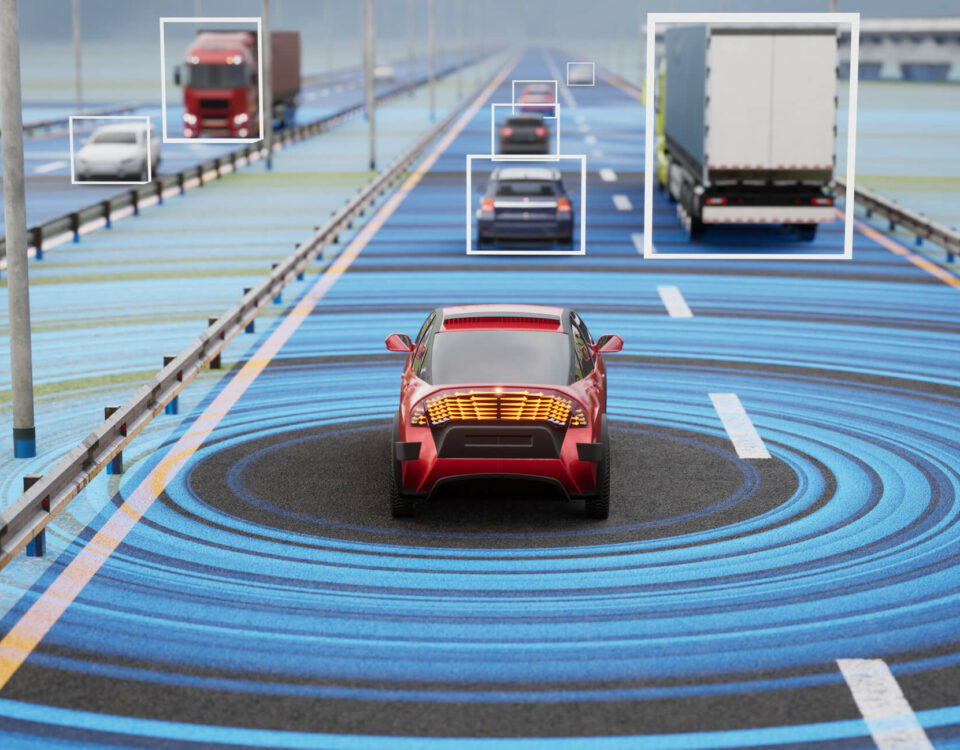
Most people still imagine a vehicle as a largely self contained machine. It may have GPS, Bluetooth, cellular service and dozens of computers, but it remains one object traveling through a separate city. V2X changes that relationship.
Vehicle to everything communication, usually shortened to V2X, allows a vehicle to exchange information beyond the reach of its own cameras, radar and driver. It can broadcast what the vehicle is doing, receive information about what is happening nearby and turn those messages into warnings or other authorized safety responses.
A vehicle approaching an intersection may learn that the signal is about to change. It may receive a warning that another vehicle is braking beyond its line of sight or that an ambulance is approaching from behind a building. That is the purpose of V2X. It gives vehicles another way to perceive the road.
The United States Department of Transportation describes V2X as communication among vehicles, infrastructure and other road users. Its national deployment plan calls for the technology to expand across highways, intersections and major metropolitan areas. The “X” does not represent one particular machine. It represents everything authorized to participate in the transportation conversation.

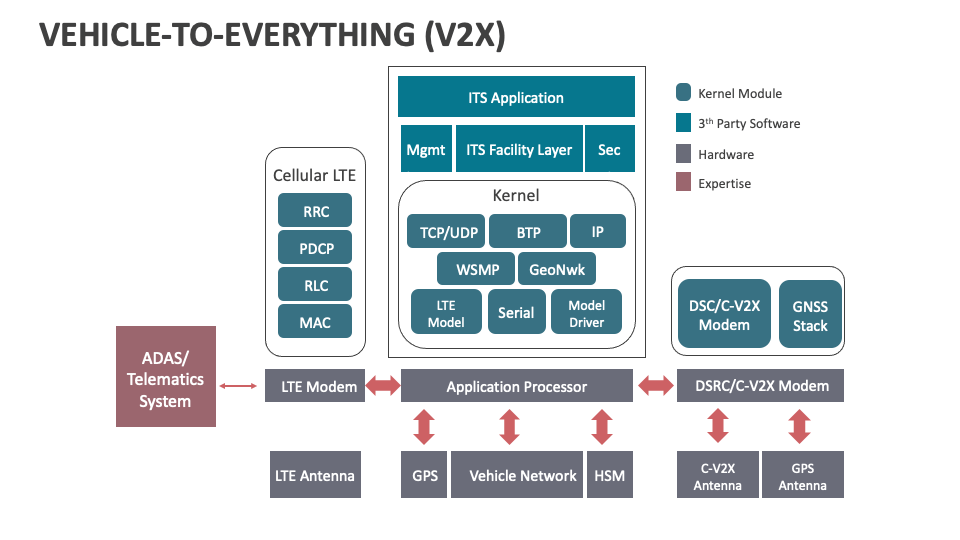
V2X is not a single sensor or antenna. Inside the vehicle, it is a communications platform built around an onboard processor, positioning technology, radio equipment, antennas, security functions and a connection to the vehicle’s internal network.
The processor receives selected operating information from the vehicle. A Basic Safety Message can include information such as the vehicle’s location, speed and direction, according to a National Highway Traffic Safety Administration explanation.
Positioning is especially important because a safety message has little value if the system cannot accurately determine where the vehicle is located. During connected vehicle testing in New York City, dense buildings created GPS challenges that required additional techniques including inertial navigation, map matching and roadside unit triangulation.
Depending on its design, a vehicle may use cellular service for longer range network communication and a dedicated V2X radio for direct communication with nearby equipped vehicles or roadside devices.
Earlier federal deployments used DSRC equipment. Later projects began replacing it with cellular V2X following changes to federal use of the 5.9 GHz spectrum.
Software running through the onboard processor determines what information should be transmitted, interprets incoming messages and decides whether something should be displayed to the driver or delivered to another authorized safety function.
The introductory image shows a reference architecture rather than the exact design of every connected vehicle. Manufacturers may combine processors, radios and telematics equipment differently.
Even antenna placement can affect communication reliability. Federal pilot deployments found that parts of large trucks could physically obstruct their own radio signals, requiring antennas to be repositioned.
The essential functions remain the same. The system must locate the vehicle, obtain selected operating data, process messages, communicate and verify trust.
V2X is not ordinarily the cabin microphone, driver facing camera or eye tracking system. Those belong to separate infotainment, telematics and driver monitoring systems. They may share hardware or exchange selected information, but they are not V2X itself.
Vehicle to vehicle communication allows cars, trucks, buses and emergency vehicles to exchange safety information.

Vehicle to infrastructure communication connects vehicles with equipped roadway systems. Vehicle to pedestrian communication can help identify pedestrians, cyclists and road workers through compatible personal devices or detection systems. Vehicle to network communication uses cellular and internet based services to move information across greater distances.
These are not simply theoretical labels. The federal Connected Vehicle Pilot Deployment Program tested onboard units in passenger vehicles, trucks, snowplows, buses and city fleets, along with roadside equipment and pedestrian warning devices.
The communication paths may work together, but V2X is not one enormous open network. Every interaction requires compatible equipment, supported message standards and a defined technical connection between participating systems.
A traffic light does not communicate with a vehicle simply because it contains electronics. It must be deliberately equipped for V2X.
For direct communication, the roadway needs a compatible radio, usually installed in a roadside unit. The vehicle needs its own onboard V2X equipment. Both sides must support compatible technology, message formats and security requirements.
The infrastructure also needs useful information to send. At an intersection, that information may come from the traffic signal controller. Its current signal state can be converted into a Signal Phase and Timing message. A digital map can describe the intersection’s lanes, approaches and permitted movements.
The vehicle combines those messages to understand what the signal is doing and which part of the intersection the information applies to. Federal research into Signal Phase and Timing applications explains how this exchange can support intersection safety, mobility and traffic flow.
The system also needs a way to establish trust. Connected vehicle deployments have required a Security Credential Management System, device certification and testing of communication between onboard and roadside units.
Those federal deployment findings demonstrate that installing radios is only one part of building a functioning V2X environment.
The roadside unit is the most important physical connection between a vehicle and public infrastructure. It may be mounted near an intersection, highway, bridge or work zone. On one side, it communicates with passing vehicles through a V2X radio. On the other, it may connect to a traffic signal controller, local sensors, communications network or transportation management platform.
That makes it a bridge between two environments.
A vehicle does not ordinarily communicate directly with every system inside the city. The roadside unit exchanges approved messages while controllers and agency platforms operate behind it through deliberately designed connections.
The United States Department of Transportation maintains an intelligent transportation systems architecture and standards framework because equipment made by different companies and operated by different agencies must still communicate predictably.
Without a compatible roadside radio, a connection to the relevant data source, standardized messages and a system for validating participants, ordinary infrastructure cannot simply speak V2X. The roadside unit gives it a voice.
V2X is becoming one of the foundations of connected transportation and broader smart city development. Federal programs have already tested integrated wireless technology inside vehicles, on mobile devices and throughout roadside infrastructure as part of a future connected transportation ecosystem.

Some of the dumbest cities are racing to call themselves smart, installing connected infrastructure faster than they can educate the people responsible for securing it. But connecting vehicles to public systems without understanding network security does not create intelligence. It creates reach. And when technology begins influencing traffic, emergency response and public safety, every unsecured connection gives a mistake, failure or attacker somewhere new to travel.
Discover more from Solide Info | The Engineer’s Authority on Cyber Defense
Subscribe to get the latest posts sent to your email.