Executive Summary
- Compare open-source CLI-driven scanning (Prowler) with agentless Security Graph CNAPP (Wiz).
- Evaluate deployment speed, ongoing maintenance costs, and multi-cloud infrastructure coverage.
- Analyze risk prioritization engines: basic compliance checks vs graph-based attack path analysis.
- Select the optimal cloud security assessment stack based on enterprise scale and resource availability.
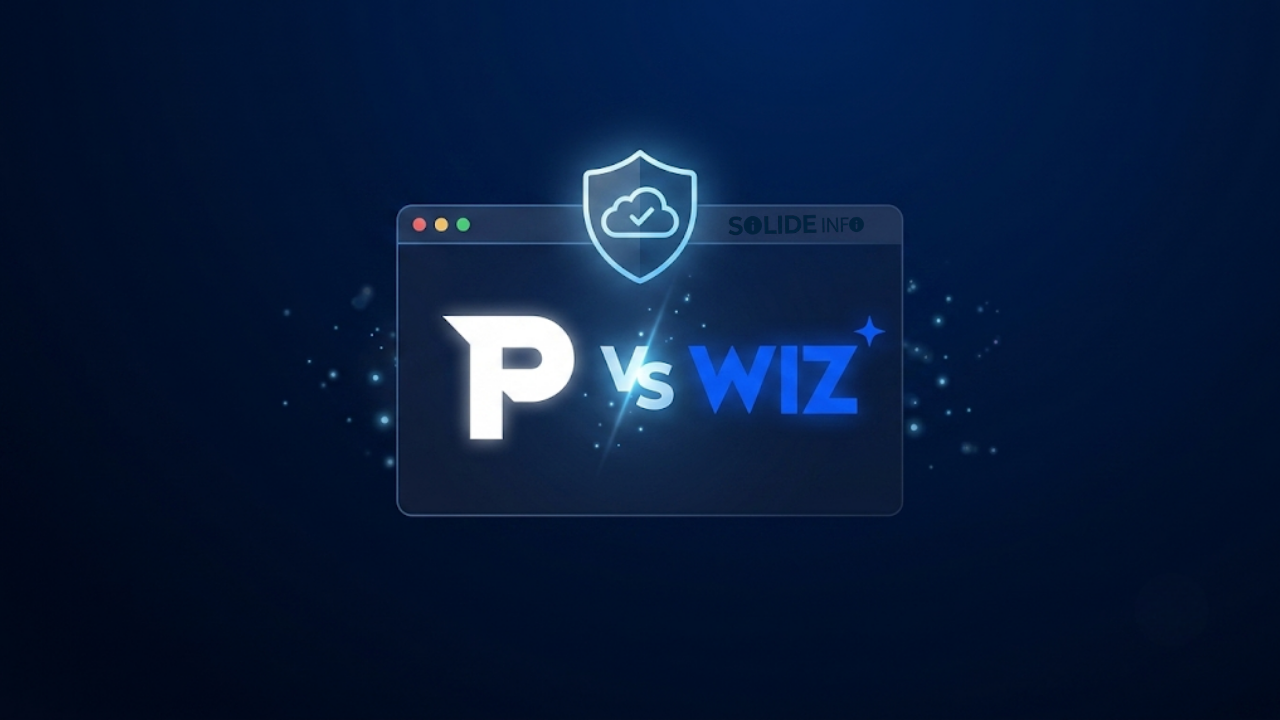
Evaluating prowler vs wiz gives cloud security architects clear guidance on choosing between open-source command-line compliance scanners and enterprise agentless CNAPP platforms.
In modern enterprise IT environments, organizations must manage increasingly complex IT ecosystems that combine multi-cloud services, containerized infrastructure, and stringent security compliance frameworks.
As workloads scale rapidly across AWS, Microsoft Azure, and Google Cloud Platform, maintaining continuous visibility into misconfigurations becomes an overwhelming operational challenge.
Security teams frequently struggle to balance the need for comprehensive posture management against rigid budgetary constraints and administrative overhead.
Choosing the right security tooling directly impacts an organization’s ability to prevent data breaches, satisfy regulatory audits, and secure modern cloud native applications.
At SolideInfo, our infrastructure engineering and cloud security divisions emphasize rigorous technical evaluation before committing to enterprise security architectures.
Understanding the structural differences between open-source community projects and commercial platforms ensures optimal allocation of engineering resources.
This comprehensive analysis compares core architectures, scanning capabilities, operational overhead, and strategic use cases to guide technical decision-makers.
Architectural Overview Prowler vs Wiz
The fundamental differences between these two security solutions lie in their underlying architecture, deployment models, and data processing methodologies.
Prowler operates primarily as an open-source command-line utility designed to audit cloud infrastructure against established security benchmarks.
Conversely, Wiz functions as a comprehensive, agentless Cloud Native Application Protection Platform (CNAPP) built around a centralized security graph database.
Analyzing these distinct architectural paradigms reveals how each platform collects telemetry and evaluates risk across enterprise cloud environments.
Prowler Engine CLI Scripts AWS CLI Credentials and CIS Benchmark Checks
Prowler leverages Python scripts and standard cloud provider command-line tools to interact directly with infrastructure APIs.
To execute an audit, the utility requires read-only IAM credentials with permissions to query resource configurations across your cloud accounts.
It systematically loops through hundreds of automated checks mapped directly to standards like CIS Benchmarks, HIPAA, GDPR, and PCI-DSS.

Because it runs as an on-demand CLI script or CI/CD pipeline job, Prowler does not maintain persistent background daemons or infrastructure inside the cloud environment.
This ephemeral execution model appeals heavily to DevOps teams seeking lightweight compliance verification during continuous integration cycles.
Wiz Architecture Agentless API Scans Tenant Snapshots and Security Graph
Wiz approaches cloud security through a deeply integrated, agentless architecture that provides holistic visibility without requiring software on individual workloads.
The platform connects to cloud management planes using secure cross-account service roles and periodically takes API snapshots of resource configurations.
Additionally, Wiz scans storage volumes, container images, and memory snapshots out-of-band, mapping every discovered asset into a unified Security Graph.

This graph database approach correlates disparate security findings—such as an exposed public IP, an over-permissioned IAM role, and a software vulnerability—into a single potential attack path.
This architectural depth allows security teams to identify critical risks that isolated misconfiguration checks routinely miss.
Open-Source Flexibility versus Enterprise Full-Stack Visibility
When contrasting open-source tools with commercial platforms, organizations must weigh cost flexibility against turnkey enterprise capabilities.
Prowler offers complete source code transparency, allowing security engineers to customize existing compliance checks or write entirely new python-based auditing modules.
However, maintaining custom rules requires dedicated internal development time and ongoing script management.
Wiz provides out-of-the-box support for multi-cloud environments, Kubernetes clusters, serverless functions, and software supply chain security.
While commercial licensing involves substantial financial investment, it relieves internal teams from building and maintaining custom integration pipelines.
Feature Matrix and Operational Comparison
Evaluating security tools requires comparing their practical feature sets across threat detection, risk prioritization, and operational efficiency.
While both platforms identify cloud misconfigurations, their reporting depth and contextual analysis differ significantly.
Security leaders must assess how each solution handles alert fatigue and integrates with existing incident response workflows.
Scanning Capabilities Compliance Benchmarks vs Full Attack Path Analysis
Prowler excels at traditional compliance auditing, generating exhaustive pass-or-fail reports aligned with recognized industry frameworks.
Its checks are precise, highly deterministic, and ideal for organizations needing to prove baseline regulatory compliance quickly.
However, Prowler’s findings are generally presented as discrete, independent items lacking deep cross-resource correlation.
Wiz shifts the focus from simple compliance to active risk prioritization through attack path analysis.
Rather than overwhelming security analysts with thousands of low-priority configuration warnings, Wiz identifies the specific toxic combinations that an attacker could exploit to compromise critical assets.

This graph-based methodology helps security operations centers focus their remediation efforts where real operational risk exists, rather than chasing phantom alerts.
Alert Fatigue and Context Linear Check Lists vs Graph-Based Prioritization
Alert fatigue is a primary driver of burnout within enterprise security operations centers.
Traditional posture management tools generate long, unstructured lists of misconfigurations, forcing analysts to manually determine which issues present immediate danger.
A single cloud environment can trigger tens of thousands of individual warnings, making manual triage practically impossible.
Wiz mitigates this challenge by calculating a prioritized risk score based on the entire context of the security graph.
If a misconfigured storage bucket contains no sensitive data and sits behind a secure private network, its risk score drops dramatically.
Conversely, an identical misconfiguration on a database containing customer records exposed to the internet is escalated to critical priority immediately.
Operational Overhead Licensing Costs and Resource Utilization
Operational overhead extends far beyond initial software acquisition costs, encompassing deployment complexity, ongoing maintenance, and team training.
Prowler requires zero financial licensing costs, making it accessible to startups and enterprises with strict budget limitations.
However, managing Prowler executions across dozens of cloud accounts requires robust internal orchestration using CI/CD pipelines, cron jobs, or container schedulers.
Wiz operates as a managed SaaS platform, eliminating infrastructure management overhead for internal IT teams.
Cloud architects deploy secure cross-account connectors once, and the platform continuously updates its vulnerability databases and compliance frameworks automatically.
Organizations must weigh the internal engineering hours required to support an open-source tool against the commercial subscription cost of an enterprise platform.
Strategic Decision Guide for Enterprise Security
Selecting the ideal cloud security posture management tool requires aligning technical capabilities with organizational maturity, budget, and compliance mandates.
Chief Information Security Officers (CISOs) and IT directors must evaluate their team’s capacity to build custom automation versus purchasing integrated enterprise solutions.
A phased adoption strategy often yields the best results for rapidly growing technology companies.
When to Choose Prowler for DevSecOps and Lightweight Audits
Prowler represents an exceptional choice for organizations with strong developer-led security cultures and limited software budgets.
Development teams can integrate Prowler directly into their GitHub Actions, GitLab CI, or Jenkins pipelines to catch misconfigurations before code reaches production environments.
It is also an invaluable tool for third-party consultants performing rapid, point-in-time security assessments for clients.
Bash
# Executing an anonymized Prowler compliance scan against an AWS environment
prowler aws --region us-east-1 --compliance cis_1.4_aws -M json-ocsf
Plaintext
# Sanitized Terminal Output Demonstration
INFO: Starting Prowler 3.x...
INFO: Selected cloud provider: AWS
INFO: Evaluating 245 checks against account 123456789012...
[PASS] check: s3_bucket_public_access_prohibited (ID: s3_01) - Resource: secure-logs-bucket
[FAIL] check: iam_all_users_no_administrative_privileges (ID: iam_14) - Resource: legacy-admin-user
INFO: Assessment complete. Total checks: 245 | Passed: 210 | Failed: 35
INFO: Report successfully written to /output/prowler-output.json
This command-line execution demonstrates Prowler’s speed and simplicity, providing actionable JSON output that developers can parse and remediate within minutes.
Anonymized Comparison Demonstration Prowler CLI Output vs Graph API Query
To further clarify the operational differences, consider how each platform investigates an overly permissive storage bucket.
With Prowler, an engineer runs a targeted CLI check that flags the specific resource identifier and rule violation.
With Wiz, an analyst queries the GraphQL API to inspect the entire blast radius associated with that specific resource.
Python
# Anonymized Python snippet querying Wiz GraphQL API for critical attack paths
import requests
import os

WIZ_API_URL = "https://api.us1.app.wiz.io/graphql"
HEADERS = {"Authorization": f"Bearer {os.environ.get('WIZ_API_TOKEN')}"}

query = """
{
  issues(filter: {severity: {EQUALS: CRITICAL}, status: {EQUALS: OPEN}}) {
    nodes {
      id
      control { name }
      sourceRule { name }
      entity { name type cloudProvider }
    }
  }
}
"""

response = requests.post(WIZ_API_URL, json={'query': query}, headers=HEADERS)
print(response.json())
Plaintext
# Sanitized Terminal Output Demonstration
{
  "data": {
    "issues": [
      {
        "id": "ISSUE-98421",
        "control": "Publicly accessible database with active CVE",
        "sourceRule": "Toxic Combination Detector",
        "entity": {
          "name": "prod-customer-db",
          "cloudProvider": "AWS"
        }
      }
    ]
  }
}
This API query demonstrates Wiz’s ability to surface complex multi-factor risks instantly, whereas Prowler would require running separate checks for vulnerabilities and network exposure.
Advanced FAQ Section
How does this technology impact enterprise IT strategy? Choosing between open-source compliance auditing and enterprise CNAPP platforms dictates how an organization manages cloud risk. While open-source tools foster developer-led security and cost efficiency, enterprise platforms provide the holistic visibility and automated risk prioritization required to secure massive, multi-cloud architectures.
What are the main implementation challenges? The primary hurdle for open-source tools like Prowler involves scaling execution across hundreds of distributed cloud accounts and managing the resulting data aggregation. For commercial platforms like Wiz, implementation challenges usually center around securing cross-account IAM trust permissions and managing remediation workflows across multiple engineering business units.
What should IT leaders consider before adopting it? Leaders must evaluate their available engineering headcount, compliance regulatory requirements, and overall cloud infrastructure scale. If the organization operates a multi-cloud environment with complex container workloads, an enterprise platform like Wiz provides essential visibility. If the focus is strictly on AWS compliance and DevSecOps pipeline gating, Prowler offers a powerful, cost-effective alternative.
Choosing the ideal posture assessment tool between prowler vs wiz depends on your organization’s budget, compliance requirements, and required speed of cloud threat detection.
Discover more from Solide Info | The Engineer’s Authority on Cyber Defense
Subscribe to get the latest posts sent to your email.