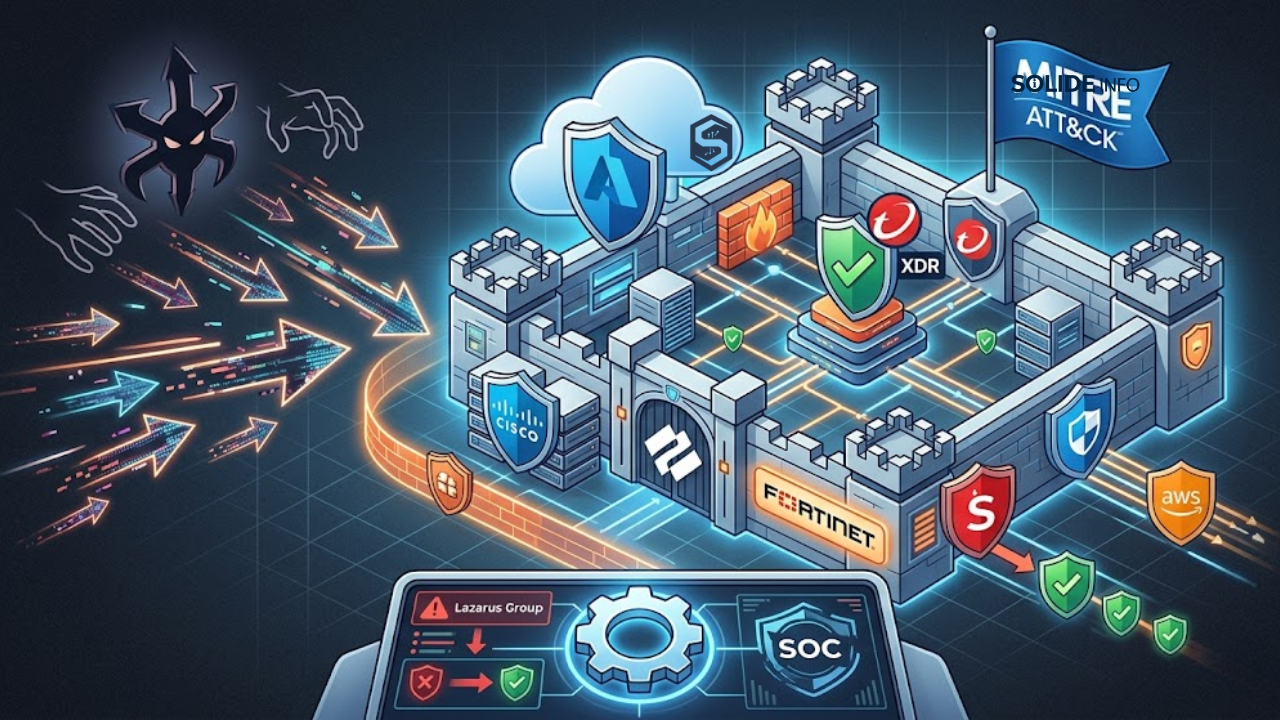
To defend modern enterprise networks, security teams must understand the tactical execution of the Lazarus Group, a highly sophisticated state-sponsored threat actor targeting global infrastructure.
Securing these environments requires transitioning from reactive security measures to proactive, intelligence-driven architecture.
This guide provides deep technical insights, architectural frameworks, and practical defense playbooks designed to protect enterprise assets from advanced persistent threats (APT).
Executive Summary
This technical guide analyzes the operational methodologies of sophisticated adversaries and provides actionable mitigation strategies for enterprise environments.
- Tactical Blueprint: Detailed deconstruction of initial access vectors, lateral movement, and advanced command-and-control (C2) mechanisms.
- Architectural Resilience: Implementing zero trust network architectures, advanced micro-segmentation, and sovereign digital identity controls.
- Operational Playbooks: Production-ready detection queries, YARA rules, and automation scripts to hunt for and neutralize active compromises.
- Strategic Compliance: Aligning national security objectives, data protection mandates, and global cyber resilience standards to ensure local data protection.
Tactical Profile and Anatomy of Lazarus Group Operations
State-sponsored cyber espionage and financial operations have evolved from simple phishing campaigns into highly coordinated, multi-stage attacks.
Defending against these advanced groups requires a deep understanding of their technical capabilities and strategic objectives.
+------------------------------------------------------------------------+
|                      LAZARUS GROUP ATTACK LIFECYCLE                    |
+------------------------------------------------------------------------+
                                    |
                                    v
                       +-------------------------+
                       |    Initial Compromise   |
                       |  (Spear-Phishing, DLL)  |
                       +-------------------------+
                                    |
                                    v
                       +-------------------------+
                       |    Evasion & Execution  |
                       |    (BYOVD, Lsass Dump)  |
                       +-------------------------+
                                    |
                                    v
                       +-------------------------+
                       |    Lateral Movement     |
                       |    (WMI, WinRM, SMB)    |
                       +-------------------------+
                                    |
                                    v
                       +-------------------------+
                       |   Command & Control     |
                       |  (Multi-stage Fallback) |
                       +-------------------------+
                                    |
                                    v
                       +-------------------------+
                       |  Action on Objectives   |
                       | (Data Exfil / Crypto)   |
                       +-------------------------+
Evolution from Financial Heists to Cryptographic and Software Supply Chain Attacks
Historically, state-sponsored cyber actors prioritized intelligence collection and political espionage.
However, groups like the Lazarus Group pioneered the use of cyber operations for direct financial acquisition.
This transition began with dramatic attacks on global interbank messaging systems, resulting in the theft of hundreds of millions of dollars.
As financial institutions hardened their perimeter defenses, these threat actors shifted their focus toward the decentralized finance (DeFi) ecosystem.
This shift targeted smart contracts, cryptocurrency exchanges, and localized investment platforms.
To execute these operations, threat actors rely heavily on advanced social engineering.
They use highly targeted spear-phishing campaigns delivered via professional networking platforms.
These campaigns often target systems administrators and software developers.
The initial delivery mechanisms frequently involve trojanized open-source utilities or poisoned software development packages.
Once inside an organization, these adversaries target code repositories and build pipelines.
By compromising the software supply chain, threat actors can inject malicious code into trusted software updates.
This allows them to compromise downstream clients globally without needing direct access to those secondary networks.
These activities represent a highly structured pipeline designed to maximize financial extraction and intelligence gathering.
Comparing Lazarus and Volt Typhoon attacks on Critical Infrastructure
Analyzing the operational differences between major state-sponsored actors reveals distinct strategic goals and execution methodologies.
This contrast is highly visible when examining the intersection of Lazarus and Volt Typhoon attacks.
| Operational Metric | Lazarus Group | Volt Typhoon |
|---|---|---|
| Primary Objective | Financial gain, espionage, and operational disruption. | Pre-positioning for disruption of critical national infrastructure. |
| Initial Access Vector | Poisoned software packages, targeted spear-phishing, DLL sideloading. | Exploitation of zero-day vulnerabilities in edge network devices (VPNs, firewalls). |
| Infrastructure Model | Custom, multi-tiered proxy networks and compromised hosting platforms. | Operational relay networks (ORNS) composed of compromised SOHO routers. |
| Evasion Tactics | Heavy code obfuscation, Bring Your Own Vulnerable Driver (BYOVD) techniques. | Extreme “Living off the Land” (LotL) execution, minimal file-backed malware. |
| Target Sectors | Finance, cryptocurrency exchanges, defense, and nuclear sectors. | Telecommunications, power grids, water treatment, and transportation. |
Lazarus operations are characterized by aggressive toolset deployments, featuring custom malware families and rootkits.
In contrast, Volt Typhoon prioritizes stealth and long-term persistence.
They often use built-in system tools like wmic, vssadmin, and PowerShell to blend in with legitimate administrative traffic.
For security operations centers (SOCs), detecting Volt Typhoon requires deep behavioral analytics and command-line monitoring.
Detecting Lazarus operations requires a combination of robust endpoint detection, software integrity validation, and anomaly detection.
Both threat models demonstrate that modern enterprise defense must be comprehensive, looking for both behavioral anomalies and known malicious files.
Command and Control Infrastructure and Malware Toolsets
Understanding the Command and Control (C2) architecture used by state-sponsored threat actors is critical for network defense.
These adversaries construct complex, multi-tiered infrastructures to shield their core operations from discovery and takedown.
                      +-----------------------------+
                      |   Target Enterprise Host    |
                      +-----------------------------+
                                     |
                                     | (Encrypted HTTP/S / DNS Tunnel)
                                     v
                      +-----------------------------+
                      |     Tier 1 Proxy Nodes      |
                      |   (Compromised SOHO/Web)    |
                      +-----------------------------+
                                     |
                                     | (Obfuscated Custom Protocol)
                                     v
                      +-----------------------------+
                      |    Tier 2 Redirectors       |
                      |    (VPS / Cloud Providers)  |
                      +-----------------------------+
                                     |
                                     | (Encrypted Tunnel)
                                     v
                      +-----------------------------+
                      |      Main C2 Controller     |
                      |   (Secure Operator Panel)   |
                      +-----------------------------+
The initial beacon from an infected host does not connect directly to the attacker’s primary server.
Instead, the payload communicates with a compromised legitimate website, often a vulnerable content management system (CMS).
This first-tier proxy helps bypass basic IP-based reputation filters, as the domain belongs to a trusted entity.
From the first-tier proxy, traffic is routed through multiple redirectors hosted on virtual private servers (VPS).
These redirectors often use custom encryption protocols designed to mimic legitimate HTTPS traffic, using valid but stolen SSL/TLS certificates.
The final stage of the network is the backend controller, where attackers monitor compromised hosts and issue commands.
The malware toolsets used in these operations are highly modular.
Typically, the initial stager gathers system information, enumerates running processes, and checks for debugging environments.
If the target host is deemed valuable, the stager downloads secondary payloads.
These payloads may include customized remote access trojans (RATs) like Dacls or Manuscrypt.
These tools can manipulate files, execute arbitrary shell commands, capture screens, and log keystrokes.
Furthermore, attackers use advanced memory execution techniques.
These techniques allow payloads to be injected directly into the memory spaces of legitimate processes like svchost.exe or explorer.exe.
This process injection bypasses traditional endpoint security agents that rely heavily on file-on-disk scanning.
Architectural Defense and Enterprise Network Hardening
Securing the enterprise against sophisticated state-sponsored hackers requires an architectural evolution.
Relying on perimeter-based security is no longer sufficient when facing adversaries who exploit trust relationships, supply chains, and zero-day vulnerabilities.
Implementing Zero Trust Architecture to Mitigate State-Sponsored Lateral Movement
Zero Trust is a core architectural framework designed to counter the lateral movement techniques used by advanced adversaries.
In a traditional network, once an attacker gains access to the internal network, they enjoy broad, unhindered access.
A Zero Trust Architecture (ZTA) operates under a continuous assumption of compromise, requiring strict verification for every access request.
                      +-----------------------------+
                      |   Subject / Enterprise Host |
                      +-----------------------------+
                                     |
                                     v
                      +-----------------------------+
                      |   Policy Decision Point     |
                      |  (Identity, Device, Context) |
                      +-----------------------------+
                                     |
                                     v
                      +-----------------------------+
                      |  Policy Enforcement Point   |
                      |  (Micro-segmented Gateway)  |
                      +-----------------------------+
                                     |
                 +-------------------+-------------------+
                 |                   |                   |
                 v                   v                   v
          +-------------+     +-------------+     +-------------+
          | App Tier A  |     | App Tier B  |     | DB Server   |
          | (Segment 1) |     | (Segment 2) |     | (Segment 3) |
          +-------------+     +-------------+     +-------------+
To build a Zero Trust framework, organizations should first map their data flows.
This process identifies how critical applications, databases, and users interact across the network.
Once mapped, micro-segmentation should be implemented to isolate workloads from one another.
This ensures that a compromise of a front-end web server does not lead to exposure of back-end database servers.
Access to these segments should be controlled by a dynamic Policy Decision Point (PDP) and enforced by a Policy Enforcement Point (PEP).
Access decisions must evaluate contextual signals in real time.
These signals include user identity validation, device health status, geolocation, time of access, and behavioral history.
Additionally, organizations should implement Mutual TLS (mTLS) for all internal communications.
mTLS ensures that both the client and server verify each other’s cryptographic identities before transmitting data.
This mitigates the risk of man-in-the-middle attacks and prevents unauthorized lateral movement within the data center.
Furthermore, privileged administrative credentials must be restricted.
These credentials should only be issued through Privileged Access Management (PAM) platforms using Just-In-Time (JIT) provisioning.
This reduces the availability of permanent administrative accounts, limiting the opportunities for attackers to harvest credentials.
Establishing Morocco Cybersecurity Digital Sovereignty Frameworks
For enterprise operations located in emerging technology hubs, regulatory compliance and operational independence are critical defensive elements.
This balance is highly visible when examining Morocco cybersecurity digital sovereignty initiatives.
The Moroccan General Directorate of Information Systems Security (DGSSI) has established strict guidelines to safeguard critical information systems (SIIV).
These mandates require organizations within vital sectors to host critical data locally.
This local hosting prevents unauthorized data access and ensures continuous operational control during geopolitical tensions.
Additionally, these guidelines require the use of security solutions that have been validated by local regulatory bodies.
Adhering to these standards requires enterprise architects to implement sovereign cloud architectures.
These hybrid or private cloud configurations ensure that decryption keys, user directory stores, and logs remain under national jurisdiction.
Furthermore, regional security operational compliance requires strict adherence to Law No. 09-08 regarding the protection of personal data.
This law requires that any data transfers outside of national boundaries receive explicit authorization from the CNDP (Commission Nationale de Contrôle de la Protection des Données à Caractère Personnel).
Integrating these compliance requirements into incident response plans ensures that local security teams can investigate breaches autonomously.
This autonomy is critical when responding to state-sponsored campaigns, as external dependencies can slow down incident containment.
Building this domestic security posture ensures long-term operational resilience and protects key economic engines from disruption.
Software Supply Chain Protection and Code-Signing Integrity
Compromising software supply chains has become a preferred initial access vector for advanced threat groups.
To defend against this, organizations must establish complete visibility and verification across their entire software development lifecycle (SDLC).
  +------------------+     +------------------+     +------------------+
  | Developer Push   | --> | Build Pipeline   | --> | Artifact Registry|
  | (Signed Commits) |     | (Static Analysis)|     | (Binary Signing) |
  +------------------+     +------------------+     +------------------+
                                                             |
                                                             v
  +------------------+     +------------------+     +------------------+
  | Deployment Stage | <-- | Policy Check     | <-- | Admission        |
  | (Verification)   |     | (Signature Verif)|     | Controller (K8s) |
  +------------------+     +------------------+     +------------------+
First, developers should sign all commits with cryptographic keys, such as GPG or SSH keys.
This ensures that only verified code changes are merged into the repository, preventing unauthorized code injections.
Next, build pipelines must be isolated.
These pipelines should run within ephemeral, locked-down containers without access to the broader internet.
This isolation prevents malicious build-time dependencies from fetching payloads from attacker-controlled servers during compilation.
Every build should generate a Software Bill of Materials (SBOM).
The SBOM provides an inventory of all third-party libraries, dependencies, and modules used in the software.
This document should be scanned continuously for known vulnerabilities using Software Composition Analysis (SCA) tools.
Once validated, binaries must be signed using a hardware security module (HSM) or a secure code-signing service.
In production environments, endpoints must be configured to execute only cryptographically signed applications.
Using application control policies, such as AppLocker or Windows Defender Application Control (WDAC), prevents the execution of unsigned binaries.
This mitigation stops custom, untrusted state-sponsored malware from running on critical systems, even if an attacker manages to drop the payload onto a target machine.
Threat Hunting, Incident Response, and Technical Detection Frameworks
Proactive threat hunting is essential for identifying sophisticated actors who have bypassed perimeter defenses.
This section provides actionable YARA rules, detection queries, and automation scripts to help SOC analysts hunt for and contain advanced threats.
+------------------------------------------------------------------------+
|                     INCIDENT RESPONSE TIMELINE CYCLE                   |
+------------------------------------------------------------------------+
                                    |
                                    v
                       +-------------------------+
                       |    Triage & Analysis    |
                       | (Log Review, Yara Run)  |
                       +-------------------------+
                                    |
                                    v
                       +-------------------------+
                       |   Containment Action    |
                       |  (Host Isolation script)|
                       +-------------------------+
                                    |
                                    v
                       +-------------------------+
                       |   Eradication Phase     |
                       |  (C2 Block, credential) |
                       +-------------------------+
                                    |
                                    v
                       +-------------------------+
                       |   Post-Incident Review  |
                       | (Update hunt rules, ZTA)|
                       +-------------------------+
Active Threat Hunting with Yara Rules and Kusto Query Language
YARA rules are a key tool for detecting specific malware patterns, malicious libraries, and configuration files on endpoints.
The following YARA rule is designed to detect indicators associated with advanced state-sponsored RATs.
This rule targets unique byte sequences, compromised DLL sideloading wrappers, and custom obfuscation patterns.
rule StateSponsored_Lazarus_RAT_Indicators {
    meta:
        description = "Detects specific binary patterns, DLL wrappers, and strings associated with Lazarus Group operations"
        author = "SolideInfo Security Research"
        date = "2024-11-20"
        severity = "Critical"
        threat_group = "Lazarus Group"
        reference = "MITRE ATT&CK G0032"

    strings:
        // Pattern matching malicious custom socket configuration strings
        $socket_config = { 41 53 59 4e 43 5f 53 4f 43 4b 45 54 5f 50 4f 4f 4c }

        // Obfuscated API resolution routine patterns
        $api_resolver = { 8B 45 ?? 83 C0 04 89 45 ?? 8B 10 85 D2 74 ?? 52 FF 15 }

        // Known custom cryptographic routine strings
        $crypto_magic = "CustomAES_256_Decrypt"
        $debug_string = "C:\\projects\\shadow_broker\\bin\\payload.pdb" ascii nocase

    condition:
        uint16(0) == 0x5A4D and (
            all of ($socket_config, $api_resolver) or
            any of ($crypto_magic, $debug_string)
        )
}
This rule can be integrated into endpoint detection tools or used during forensic acquisitions to identify infected systems.
Complementing host-based YARA scanning, Kusto Query Language (KQL) allows threat hunters to query centralized logs within Microsoft Sentinel or Defender for Endpoint.
The following KQL query searches for living-off-the-land techniques.
Specifically, it targets the abuse of rundll32.exe loaded from unusual paths or executing suspicious exports. This is a common mechanism used by attackers to execute payloads.
DeviceProcessEvents
| where ProcessCommandLine has "rundll32.exe"
| where not(FolderPath startswith @"c:\windows\system32\")
  and not(FolderPath startswith @"c:\windows\syswow64\")
| extend TargetDLL = tostring(split(ProcessCommandLine, ",")[0])
| extend Exporter = tostring(split(ProcessCommandLine, ",")[1])
| where TargetDLL !endswith ".cpl" and TargetDLL !endswith ".inf"
| project TimeGenerated, DeviceName, AccountName, FolderPath, ProcessCommandLine, TargetDLL, Exporter
| order by TimeGenerated desc
This query filters out standard Windows system paths, leaving suspicious executions for analyst review.
By monitoring these anomalies, threat hunters can identify and flag execution bypass attempts before attackers establish a permanent foothold.
Automated Incident Response Workflows for Post-Compromise Containment
When an indicator of compromise (IOC) is validated, incident responders must act quickly to contain the threat.
Automation helps minimize attacker dwell time and prevents lateral movement across the network.
The following PowerShell script is designed to isolate an compromised endpoint.
It disables network adapters, terminates active malicious connections, and collects volatile memory forensics for analysis.
<#
.SYNOPSIS
    Automated Incident Response Endpoint Isolation and Forensics Triage Script.
    Designed to isolate compromised hosts and collect volatile forensic data.
.DESCRIPTION
    This script is intended for use by authorized incident response teams.
    It performs immediate host isolation and gathers key forensics.
#>

[CmdletBinding()]
param (
    [string]$ForensicsOutputDirectory = "C:\IR_Triage_Data",
    [bool]$IsolateNetwork = $true
)

# Check administrative privileges
$currentUser = [Security.Principal.WindowsPrincipal][Security.Principal.WindowsIdentity]::GetCurrent()
if (-not $currentUser.IsInRole([Security.Principal.WindowsBuiltInRole]::Administrator)) {
    Write-Error "This script must be executed with elevated administrative privileges."
    Exit 1
}

# Create triage directory structure
if (-not (Test-Path $ForensicsOutputDirectory)) {
    New-Item -ItemType Directory -Force -Path $ForensicsOutputDirectory | Out-Null
}

Write-Host "[*] Starting volatile data collection..." -ForegroundColor Cyan

# Collect network connections
Get-NetTCPConnection | Export-Csv -Path "$ForensicsOutputDirectory\NetworkConnections.csv" -NoTypeInformation

# Collect running processes with execution paths
Get-Process | Select-Object Id, Name, Path, Company, StartTime | Export-Csv -Path "$ForensicsOutputDirectory\ProcessInventory.csv" -NoTypeInformation

# Collect active DNS cache entries
Get-DnsClientCache | Export-Csv -Path "$ForensicsOutputDirectory\DNSCache.csv" -NoTypeInformation

Write-Host "[*] Volatile data collection complete." -ForegroundColor Green

# Isolate network if enabled
if ($IsolateNetwork) {
    Write-Host "[!] Initiating network isolation..." -ForegroundColor Yellow

    # Retrieve non-loopback active physical adapters
    $adapters = Get-NetAdapter | Where-Object { $_.Status -eq "Up" -and $_.PhysicalMediaType -eq "802.3" }

    foreach ($adapter in $adapters) {
        Write-Host "[!] Disabling network interface: $($adapter.Name)" -ForegroundColor Red
        Disable-NetAdapter -Name $adapter.Name -Confirm:$false
    }

    # Configure localized firewall rules to block inbound and outbound traffic
    New-NetFirewallRule -DisplayName "IR_Isolation_Block_All_In" -Direction Inbound -Action Block -Profile Any -Enabled True | Out-Null
    New-NetFirewallRule -DisplayName "IR_Isolation_Block_All_Out" -Direction Outbound -Action Block -Profile Any -Enabled True | Out-Null

    Write-Host "[+] Host successfully isolated from the local network." -ForegroundColor Green
}
This script provides incident response teams with a fast, automated way to protect the network while preserving critical forensic evidence.
Implementing such workflows within enterprise systems ensures consistent and rapid execution during a security crisis.
Network Traffic Analysis and Command and Control Beaconing Detection
Identifying command and control (C2) channels requires deep network visibility and behavioral analysis.
State-sponsored attackers often use Domain Generation Algorithms (DGA) and encryption methods designed to bypass standard firewalls.
       [ Malicious Client ]
                |
                | (Unusual HTTP Header / Content-Type)
                v
       [ Local Firewall / Proxy ]
                |
                +---> Payload Entropy: High
                +---> Target JARM: Non-Standard
                +---> SSL/TLS SNI: Mismatch
                |
                v
       [ Security Analytics Platform ]
       (Alert triggered: C2 Beaconing suspected)
To detect these operations, security teams should focus on several key network behaviors:
- JARM Fingerprinting: JARM is an active TLS server fingerprinting tool. Threat actors often use specific configurations of C2 frameworks like Cobalt Strike or Covenant, which produce distinct JARM signatures. Comparing JARM hashes against your environment can help expose hidden threat infrastructure.
- Request Entropy Analysis: Malicious beacons often use custom encryption to encapsulate data within standard HTTP headers, cookies, or POST bodies. Analyzing this traffic for high entropy (unusual randomness in characters) can help identify encrypted C2 communication hiding in plain text protocols.
- Periodic Beaconing Intervals: Unlike human browsing, which is irregular, automated beacons often check in at specific intervals. Security tools can use mathematical algorithms to identify periodic traffic patterns, even when attackers use jitter to randomize communication intervals.
The following Python script analyzes DNS query logs to detect high-entropy domain names.
This calculation helps identify potential DGA domains, which are commonly used in advanced threat infrastructure.
import math
import collections

def calculate_shannon_entropy(domain_name: str) -> float:
    """
    Calculates the Shannon Entropy of a given domain name string.
    High entropy indicates potential obfuscation, encryption, or algorithm-generated names.
    """
    # Exclude top-level domains to prevent skewing the entropy calculation
    parsed_domain = domain_name.split('.')[0]

    if not parsed_domain:
        return 0.0

    probabilities = [float(frequency) / len(parsed_domain)
                     for frequency in collections.Counter(parsed_domain).values()]

    entropy = -sum(p * math.log(p, 2) for p in probabilities)
    return round(entropy, 4)

# Demonstration cases
domains_to_evaluate = [
    "microsoft",
    "secure-login-portal",
    "ax92b1k892mz9asdf8", # Potential DGA domain
    "google-analytics"
]

print("Domain Entropy Analysis Results:")
print("-" * 45)
for domain in domains_to_evaluate:
    entropy_score = calculate_shannon_entropy(domain)
    # Typically, an entropy score above 3.5 in short subdomains indicates anomalous generation
    status = "Anomalous (High Entropy)" if entropy_score > 3.5 else "Normal"
    print(f"Domain: {domain:<20} | Entropy: {entropy_score:<6} | Status: {status}")
Using this analysis in your DNS monitoring tools can flag anomalous activity, allowing security analysts to investigate potential C2 channels before data exfiltration occurs.
Advanced FAQ
How do modern zero trust architectures limit state-sponsored lateral movement?
Modern Zero Trust architectures limit lateral movement by enforcing strict micro-segmentation, continuous identity validation, and process isolation.
When an attacker compromises an endpoint, they are confined to that specific segment.
They cannot query Active Directory or scan other network assets without triggering policy alerts.
Furthermore, access requests must be validated by the Policy Enforcement Point using multiple contextual signals.
This means that even if an attacker has stolen credentials, they cannot access critical databases or applications from an unauthorized or unhealthy device.
This approach prevents minor endpoint compromises from turning into major network-wide breaches.
Why do advanced threat groups target local critical infrastructure?
Advanced threat groups target local critical infrastructure to achieve strategic advantages and gain political leverage.
In modern conflict, the ability to disrupt power grids, water systems, and communications networks is a powerful tool.
Furthermore, attacking critical infrastructure can lead to economic disruption and weaken public trust in defensive systems.
This threat model requires critical entities to implement robust, air-gapped systems and highly resilient incident response plans.
Protecting these systems is vital for national security and the preservation of essential public services.
What are the challenges in maintaining code-signing infrastructure security?
The primary challenge in maintaining code-signing security is protecting and managing the underlying cryptographic private keys.
If an attacker compromises these keys, they can sign malicious payloads, making them appear as legitimate, trusted software updates.
To mitigate this risk, organizations must store their code-signing keys within high-assurance Hardware Security Modules (HSMs).
Additionally, they should implement strict access controls and require multi-signature approval for any signing operations.
Without these protections, code-signing systems can become high-value targets for advanced threat actors.
How does regional data sovereignty impact response times during cyber incidents?
Regional data sovereignty impacts incident response times by requiring security data and investigations to remain under local jurisdiction.
When security logs, forensic images, and telemetry are hosted locally, incident response teams can access and analyze this data without needing external approvals.
However, organizations must ensure that their local teams are properly trained and have the necessary tools to investigate complex attacks independently.
By building localized capabilities, organizations can maintain compliance with regional data laws while responding quickly and effectively to cyber threats.
What is JARM and how does it assist in threat detection?
JARM is an active TLS server fingerprinting tool developed by Salesforce.
It works by sending customized TLS Client Hello packets to a target server and analyzing the server’s specific responses.
The resulting fingerprint is unique to the server’s operating system, library versions, and configuration settings.
Because state-sponsored actors often use specific server configurations for their C2 nodes, JARM allows defenders to identify malicious infrastructure, even when attackers use new domain names or IP addresses.
Adding JARM checks to security workflows helps identify and block threat actor infrastructure at the network boundary.
How can organizations defend against DLL side-loading attacks?
Defending against DLL side-loading attacks requires a combination of application control policies and behavioral monitoring.
Organizations should implement Windows Defender Application Control (WDAC) to prevent the execution of unauthorized or unsigned DLLs.
Additionally, security teams should configure endpoint detection and response (EDR) platforms to monitor process execution anomalies.
Specifically, look for trusted system binaries loading DLLs from non-standard directories (such as the Temp or Downloads folders).
Enforcing directory permissions that prevent standard users from writing to system paths also helps mitigate this threat.
Why is software supply chain security critical for modern enterprises?
Software supply chain security is critical because modern enterprises rely heavily on third-party libraries, open-source code, and software-as-a-service (SaaS) applications.
If an attacker compromises any element of this supply chain, they can bypass traditional perimeter defenses and gain access to the enterprise network.
This risk requires organizations to implement strict verification protocols, maintain accurate Software Bills of Materials (SBOMs), and continuously scan for vulnerabilities.
Securing the supply chain is essential for protecting intellectual property and maintaining operational trust.
Securing the modern enterprise against advanced persistent threats requires a proactive defense-in-depth strategy.
By combining zero trust principles, micro-segmentation, and automated incident response workflows, security teams can effectively limit the impact of state-sponsored operations.
Furthermore, aligning network defenses with sovereign security frameworks helps ensure compliance and long-term operational resilience.
As adversaries continue to refine their tactics, maintaining continuous visibility and updating defensive postures is the only viable path to neutralizing the threat of the Lazarus Group.
Discover more from Solide Info | The Engineer’s Authority on Cyber Defense
Subscribe to get the latest posts sent to your email.