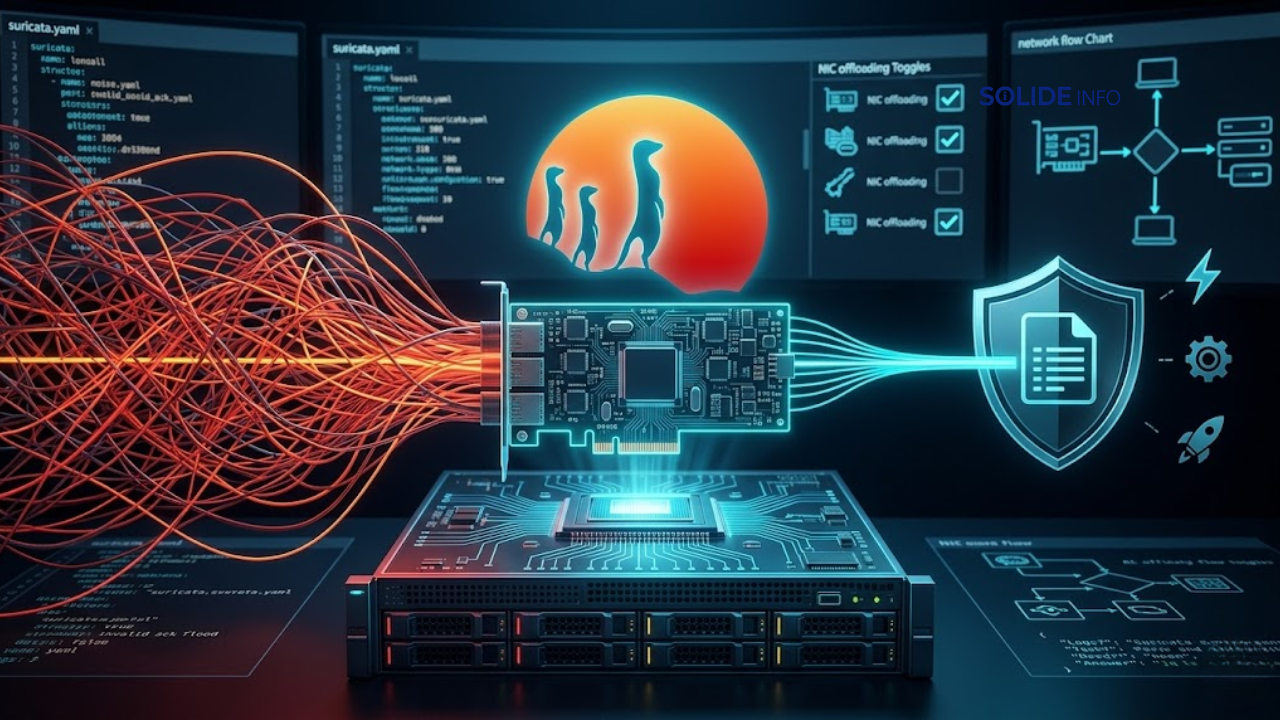
In a post-compromise scenario where forensic visibility is compromised by packet truncation, an optimized network intrusion detection system is the only line of defense. Every sensor deployed behind a SPAN port eventually hits a performance wall: millions of SURICATA STREAM invalid ack alerts that bury legitimate lateral movement in technical noise.
This technical pillar article dismantles the root causes of IDS noise—from NIC hardware offloading to kernel-level packet mirroring—providing a production-ready blueprint for elite DFIR operations.
Executive Summary
Deploying a high-throughput IDS requires more than just installing a binary. In virtualized environments like Proxmox or ESXi, the interaction between the virtual bridge and the Suricata stream engine often results in massive false-positive generation.
- Checksum Validation: Hardware offloading on mirror ports leads to “invalid” checksums that cause Suricata to drop legitimate traffic silently.
- NIC Tuning: GRO, LRO, and TSO must be disabled to prevent the “packet bunching” that breaks stateful stream reassembly.
- Mirroring Logic: Standard Linux bridges learn MAC addresses, necessitating
tc(Traffic Control) mirroring to ensure the IDS sees unicast traffic. - Rule Management: Strategic use of
disable.confis required to prune high-volume, low-signal stream events without compromising detection depth.
The Technical Anatomy of a Network Intrusion Detection System
A modern network intrusion detection system operates on the principle of stateful stream reassembly. Unlike simple packet filters, Suricata’s Stream Engine tracks the state of every TCP connection. It must handle out-of-order packets, retransmissions, and overlapping fragments to accurately detect multi-stage exploits.
When Suricata receives a packet from a SPAN (Switched Port Analyzer) port, it often encounters a discrepancy. The originating NIC may have performed “Checksum Offloading,” where the CRC is calculated in hardware at the last millisecond before the packet hits the wire. The mirror port, however, captures the packet before this calculation is finalized or after it has been stripped by the virtual switch.
The Problem of Stream Engine Asymmetry
If the stream engine sees only one side of a conversation (asymmetric routing) or receives packets with “incorrect” checksums, it triggers the STREAM module alerts. This is not a security event; it is a protocol validation failure. In a production Tier 3 SOC, these alerts account for up to 95% of disk I/O on log partitions, masking real threats like ET EXPLOIT or ET CNC signatures.
Forensic Artifact Analysis
To diagnose why your detection pipeline is failing, we must analyze the EVE.json metadata. Forensic analysts should pivot from the alert log to the flow log to determine if packets are being dropped due to engine exhaustion or protocol rejection.
Log Logic: Identifying the “Invalid ACK” Signature
When analyzing Suricata logs, look for high-frequency SIDs (Signature IDs) that indicate a tuning requirement rather than a breach. The following event logic is typical of a misconfigured SPAN-based sensor:
| Event ID / SID | Description | Technical Cause |
| 2210045 | STREAM invalid ack | TCP ACK number outside of the expected window. |
| 2210042 | STREAM TCP Small Window | Excessive window scaling issues in virtualized kernels. |
| 2200003 | IPv4 Truncated Packet | Packet length mismatch (often MTU/VLAN tag related). |
| 2210053 | STREAM 3-way handshake with wrong seq | Out-of-order packet arrival on the monitoring interface. |
Correlating with Endpoint Logs
In a mature DFIR workflow, we correlate Suricata flow_id with Windows Event ID 3 (Network Connection). If Sysmon records a connection that Suricata fails to alert on, the issue is likely “Checksum Rejection,” where the IDS discarded the packet before the signature engine could see it.
IR Workflow: Detection to Eradication
Fixing a noisy network intrusion detection system requires a layered approach. We must tune the hardware, the kernel, and finally the application configuration.
Phase 1: NIC Hardware Tuning
The first step is to prevent the Network Interface Card (NIC) from “optimizing” the traffic before it reaches Suricata. Use ethtool to disable offloading features that interfere with raw packet capture.
Bash
# Disable Generic Receive Offload (GRO) and Large Receive Offload (LRO)
# These features combine small packets into larger ones, which breaks Suricata's timing.
sudo ethtool -K ens19 gro off lro off tso off gso off

# Verify the changes
sudo ethtool -k ens19 | grep -E 'generic-receive-offload|large-receive-offload'
Phase 2: Virtualization Mirroring (Proxmox/KVM)
Standard Linux bridges (vmbr) are not designed for IDS sensors. They perform MAC learning and will not forward unicast traffic to your Suricata VM unless the MAC address is explicitly present on the virtual port. To fix this, we use tc (Traffic Control) to mirror all traffic from the bridge to the IDS tap interface.

Phase 3: Suricata Configuration Tuning
Once the traffic is reaching the interface, we must tell Suricata to stop being “picky” about checksums on the mirror port.
YAML
# /etc/suricata/suricata.yaml snippet

# 1. Disable Checksum Validation globally for the Stream engine
stream:
  memcap: 1gb
  checksum-validation: no
  inline: no

# 2. Disable Checksum checks for the specific AF_PACKET interface
af-packet:
  - interface: ens19
    cluster-id: 99
    cluster-type: cluster_flow
    defrag: yes
    checksum-checks: no # Critical for SPAN/TAP
    copy-mode: ips
    copy-iface: eth1
Phase 4: Ruleset Optimization
Even with the fixes above, certain benign traffic patterns will trigger stream alerts. We use suricata-update and a disable.conf file to surgically remove noise.
Bash
# /etc/suricata/disable.conf
# Remove high-volume stream noise that provides zero security value
2210045 # STREAM invalid ack
2210042 # STREAM TCP Small Window
2210043 # STREAM TCP Window update
2210044 # STREAM TCP Window scale
2210053 # STREAM 3-way handshake with wrong seq
Run the update to apply the changes:
suricata-update --disable-conf /etc/suricata/disable.conf
Scaling with AI and LLMs for Automation
The future of the network intrusion detection system lies in AI-driven security. High-density SOCs generate more logs than a human analyst can review. By integrating Large Language Models (LLMs) with the EVE.json output, we can automate anomaly detection.
Automation Logic
- Ingestion: Stream Suricata logs into a vector database.
- Contextualization: Use CTI (Cyber Threat Intelligence) to tag IoCs (Indicators of Compromise).
- LLM Reasoning: Train a model to distinguish between “Protocol Noise” (like the stream errors we discussed) and “Exploit Artifacts.”
For example, a Python-based automation script can pivot from a Suricata alert to a MISP instance to check if the source IP is a known malicious actor before paging an on-call analyst.
Python
import json
import requests

def check_misp_threat(source_ip):
    # MISP API Integration for IoC pivoting
    misp_url = "https://misp.solideinfo.internal/attributes/restSearch"
    headers = {"Authorization": "YOUR_API_KEY", "Accept": "application/json"}
    payload = {"value": source_ip}

    response = requests.post(misp_url, headers=headers, json=payload)
    return response.json().get('response', [])

# Process EVE.json alert
def process_alert(alert_line):
    data = json.loads(alert_line)
    src_ip = data.get('src_ip')
    if check_misp_threat(src_ip):
        print(f"[CRITICAL] Malicious IP {src_ip} detected in Suricata stream!")
Enterprise vs. Open Source Tooling Comparison
Choosing the right network intrusion detection system depends on your scale and budget.
| Feature | Suricata (Open Source) | Corelight (Zeek Enterprise) | Cisco Secure IDS |
| Primary Strength | Signature & Protocol | Metadata & Content | Managed Integration |
| Performance | High (Multi-threaded) | Very High (Event-driven) | Medium |
| Cost | Free (License-wise) | High | Enterprise Subscription |
| Customization | Infinite | High (Zeek Scripts) | Low |
Deep-Tech FAQ
Why does checksum-validation: no not decrease security?
In a SPAN/TAP environment, the IDS is a passive observer. It is not dropping packets in a “live” stream (like an IPS would). By disabling validation, you are ensuring the engine parses the content of the packet regardless of whether the layer 4 header was recalculated correctly by a virtual bridge.
How do I calculate stream.memcap?
A general rule of thumb for a production network intrusion detection system is:
$$Memcap = (Average Flow Duration \times Bandwidth) \times 2$$
For a 1Gbps link, a memcap of 1GB to 2GB is usually sufficient for most enterprise traffic profiles.
Why use tc mirroring instead of ovs-vswitch?
While Open vSwitch (OVS) supports native mirroring, tc is more performant on standard Linux bridges (Proxmox default). It operates at the ingress/egress qdisc level, ensuring that even “invisible” unicast packets are copied to the Suricata tap interface.
CTI Integration: MISP and IoC Pivoting
To achieve “Elite” status, your network intrusion detection system must be part of a larger ecosystem. Ingesting MISP feeds directly into Suricata using suricata-update allows you to pivot from generic protocol alerts to specific threat-actor tracking.
- Feed Ingestion: Configure
suricata-updateto pull from your internal MISP instance. - Tagging: Use
flowbitsto tag traffic from known C2 (Command and Control) subnets. - Visualization: Push the results to a dashboard (Wazuh or ELK) to visualize the relationship between stream failures and actual intrusion attempts.
By mastering the nuances of stream engine tuning and virtualized networking, you transform your network intrusion detection system from a noise generator into a surgical forensic tool. Implementing these fixes ensures that your sensor remains resilient, accurate, and ready for the next high-stakes incident response engagement.
Discover more from Solide Info | The Engineer’s Authority on Cyber Defense
Subscribe to get the latest posts sent to your email.