When an application developer chooses AES-256-CBC without pairing it with a MAC, and without understanding what “padding oracle” means at the protocol level, they have not implemented encryption.
They have implemented the illusion of encryption.
The AES GCM mode versus AES-256-CBC debate is not academic. It has produced real, exploitable vulnerabilities in TLS implementations (BEAST, Lucky Thirteen, POODLE), VPN configurations, and application-layer encryption libraries still running in production today. Choosing the wrong mode does not just reduce security margins — it can make your entire encryption layer bypassable without ever touching the key.
This article gives L2/L3 analysts, security architects, and software engineers the full technical picture: how both modes work internally, where each fails, what the forensic signals look like when they’re being exploited, and exactly how to make the right choice — or migrate away from the wrong one.
Technical TL;DR — 4 Key Takeaways
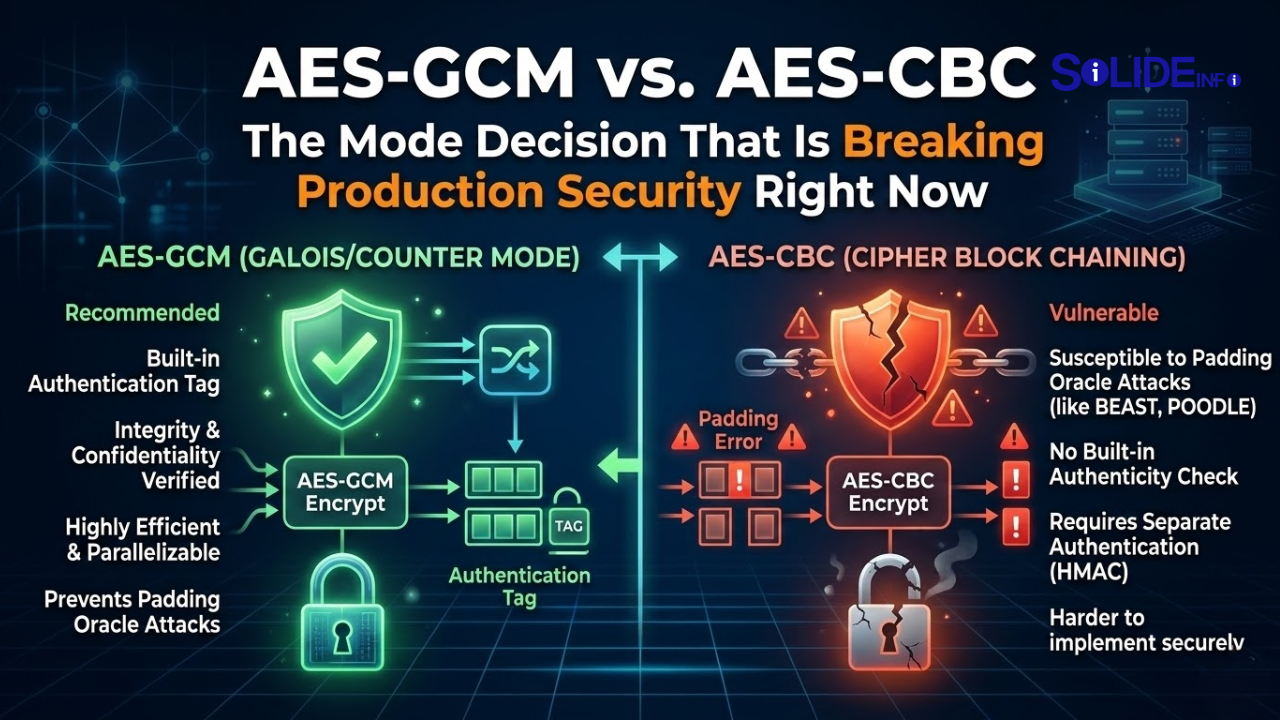
1. AES-256-GCM is an AEAD cipher (Authenticated Encryption with Associated Data). It provides confidentiality and integrity in a single operation. AES-256-CBC provides confidentiality only — integrity requires a separate, correctly implemented MAC.
2. CBC without Encrypt-then-MAC is vulnerable to padding oracle attacks. This is not theoretical — it has been weaponized in Lucky Thirteen (2013), POODLE (2014), and numerous application-layer implementations since.
3. GCM has its own critical fragility: nonce reuse with the same key destroys security completely, allowing authentication key recovery and ciphertext forgery. The 96-bit random nonce must never repeat.
4. For any new production system — APIs, file encryption, database field encryption, VPN, TLS — AES-256-GCM is the correct default. CBC is a legacy-compatibility mode only.
The Technical Anatomy of AES GCM Mode
To understand why AES GCM mode wins the production security debate, you need to understand what it actually computes — not just that it “adds authentication.”
How GCM Works Internally
GCM (Galois/Counter Mode) is a composition of two operations:
CTR Mode (Counter Mode) — Encryption
GCM uses AES in CTR mode for the actual encryption. A counter block is constructed from the nonce and a counter value, encrypted with AES, and the resulting keystream is XORed with plaintext. The encryption of each block is independent — this is what makes GCM parallelizable.
Counter Block = Nonce (96 bits) || Counter (32 bits)
Keystream_i  = AES_K(Counter_i)
Ciphertext_i = Plaintext_i XOR Keystream_i
GHASH — Authentication
GCM uses GHASH, a polynomial hash function over GF(2¹²⁸), to authenticate both the ciphertext and any Additional Authenticated Data (AAD). AAD is data that is authenticated but not encrypted — useful for packet headers, protocol metadata, or database record IDs that must be integrity-protected but don’t need confidentiality.
H = AES_K(0^128)                  // Hash subkey — derived from key
GHASH(H, A, C) = polynomial over GF(2^128)
                 using AAD (A) and ciphertext (C)
Tag = AES_K(J0) XOR GHASH(H, A, C)
The 128-bit authentication tag is appended to the ciphertext. On decryption, GCM recomputes the tag and compares it in constant time. Any single-bit modification to the ciphertext, AAD, or tag causes decryption to fail immediately — before any plaintext is returned to the application.
This is the property that makes AES GCM mode an AEAD scheme. The guarantee is: if decryption succeeds, the ciphertext was produced by someone holding the key and has not been modified since.
How AES-256-CBC Works Internally
CBC (Cipher Block Chaining) processes plaintext in 128-bit blocks. Each plaintext block is XORed with the previous ciphertext block before encryption. The first block is XORed with the Initialization Vector (IV).
C_0 = AES_K(P_0 XOR IV)
C_1 = AES_K(P_1 XOR C_0)
C_i = AES_K(P_i XOR C_{i-1})
Decryption reverses this:
P_i = AES_K^{-1}(C_i) XOR C_{i-1}
P_0 = AES_K^{-1}(C_0) XOR IV
The critical property: CBC decryption of any single block only requires the previous ciphertext block. This is what enables the padding oracle attack — you can decrypt individual blocks in isolation by manipulating the preceding ciphertext block and observing whether the decrypted result has valid PKCS#7 padding.
CBC provides zero authentication. If an attacker flips any bit in ciphertext block C_i, the corresponding bit in plaintext block P_{i+1} flips deterministically — with no detection mechanism unless an external MAC is present.

Why AES-256-CBC Without MAC Is an Active Vulnerability
The padding oracle attack against CBC is not theoretical legacy research. It is a live exploitation technique that works against any CBC implementation that leaks whether decryption padding is valid — through error messages, HTTP response codes, timing differences, or exception types.
The Padding Oracle Attack — Step by Step
PKCS#7 padding works by appending N bytes of value N to reach a block boundary. A full padding block (16 bytes of value 0x10) is appended when the plaintext is already block-aligned.
What an attacker needs:
- Access to a decryption oracle (any system that decrypts CBC ciphertext and returns a distinguishable response for “valid padding” vs “invalid padding”)
- The ciphertext to decrypt (the key is NOT needed)
The attack process for one block:
To decrypt ciphertext block C_i, the attacker manipulates the preceding ciphertext block C_{i-1} byte by byte:
For the last byte (targeting padding value 0x01):
  Try all 256 values for C_{i-1}[-1]
  When decryption says "valid padding", the decrypted last byte of C_i is 0x01
  Therefore: AES_K^{-1}(C_i)[-1] = 0x01 XOR modified_C_{i-1}[-1]

For the second-to-last byte (targeting padding value 0x02):
  Fix last byte to produce 0x02, try all 256 values for C_{i-1}[-2]
  Continue until all 16 bytes are recovered
This requires at most 256 × 16 = 4,096 oracle queries per block. A 1MB file with 65,536 ciphertext blocks requires approximately 268 million queries — feasible over a network with automated tooling.
Bleichenbacher’s attack (RSA-PKCS#1 v1.5) follows the same oracle principle. The padding oracle concept is not AES-specific — it applies to any block cipher in CBC mode with observable padding validation.
Lucky Thirteen — Timing-Based Padding Oracle
Lucky Thirteen (2013, Al Fardan and Paterson) demonstrated that even without explicit error message differentiation, CBC padding oracles can be exploited through timing side channels. CBC decryption with invalid padding terminates MAC verification early — producing a measurable timing difference of approximately 7.3 nanoseconds in the original OpenSSL implementation.
This required statistical analysis across thousands of queries, but it demonstrated that “no error message differentiation” is insufficient protection — constant-time HMAC verification is mandatory.
Event IDs and logs to monitor for padding oracle exploitation attempts:
| Source | Event / Log Field | Indicator |
|---|---|---|
| Web server (Apache/Nginx) | HTTP 500 / HTTP 200 with varying latency | High-frequency requests with same URI, varying ciphertext |
| Application logs | InvalidPaddingException, BadPaddingException, javax.crypto.BadPaddingException | Any burst of padding exceptions from a single source IP |
| WAF logs | Repeated POST requests with binary payload modifications | Identical structure, incrementally modified last 16 bytes |
| Sysmon Event ID 3 | Network connections | High-frequency connections from a single IP to an encryption endpoint |
| Windows Security 4625 | Logon failures | If padding oracle is being used to forge authentication tokens |
KQL query for padding oracle detection in Azure Sentinel:
// Detect potential padding oracle attack pattern against a web application
// Look for high-frequency requests with similar URI patterns and varying response times
let threshold_requests = 100;
let time_window = 5m;
W3CIISLog
| where TimeGenerated > ago(1h)
| where scStatus in ("500", "200", "400")
| where csUriStem has_any ("/decrypt", "/api/auth", "/token", "/session")
| summarize
    RequestCount = count(),
    UniquePayloads = dcount(csUriQuery),
    AvgTimeTaken = avg(TimeTaken),
    MaxTimeTaken = max(TimeTaken),
    MinTimeTaken = min(TimeTaken)
    by bin(TimeGenerated, time_window), cIP, csUriStem, scStatus
| where RequestCount > threshold_requests
| where (MaxTimeTaken - MinTimeTaken) > 50  // Timing variance in ms — Lucky 13 signal
| project TimeGenerated, cIP, csUriStem, scStatus, RequestCount, AvgTimeTaken, MaxTimeTaken - MinTimeTaken
| order by RequestCount desc
The GCM Nonce Problem — Where AES GCM Mode Becomes Fragile
GCM is the correct choice for production. But engineers who understand GCM’s architecture know it has one catastrophic failure mode: nonce reuse.
If the same (Key, Nonce) pair is ever used to encrypt two different messages, the following happens:
C1 = P1 XOR AES_K(Nonce || 1) XOR AES_K(Nonce || 2) ...
C2 = P2 XOR AES_K(Nonce || 1) XOR AES_K(Nonce || 2) ...

C1 XOR C2 = P1 XOR P2
An attacker who observes both ciphertexts can XOR them together to obtain the XOR of the two plaintexts. If either plaintext has any known structure (HTTP headers, JSON fields, file magic bytes), large portions of both plaintexts can be recovered.
Worse: nonce reuse in GCM also allows authentication key recovery. The GHASH subkey H = AES_K(0¹²⁸) can be recovered algebraically from two ciphertexts with the same nonce. Once H is known, the attacker can forge authentication tags for arbitrary ciphertexts — completely breaking the AEAD guarantee.
Nonce Generation Strategies
Option 1 — Random 96-bit Nonce (Standard)
Generate 12 bytes from a CSPRNG for each encryption. The birthday paradox means nonce collision probability becomes non-negligible after approximately 2⁴⁸ encryptions with the same key (~281 trillion messages). For most applications, key rotation long before this boundary is practical.
import os
nonce = os.urandom(12)  # 96-bit nonce — never reuse with same key
NIST SP 800-38D recommendation: Rotate the key after 2³² (approximately 4.3 billion) random nonce generations to keep collision probability below 2⁻³² — a practical safety margin for high-volume systems.
Option 2 — Deterministic Counter-Based Nonce
For systems that track state, a monotonically increasing 96-bit counter provides guaranteed uniqueness without randomness. This is the approach used by TLS 1.3 (sequence number XORed with the write IV).
import struct

class NonceCounter:
    """
    Thread-safe deterministic nonce counter for AES-256-GCM.
    Guarantees uniqueness — eliminates nonce reuse risk entirely.
    Must be persisted across restarts to prevent counter reuse.
    """
    def __init__(self, initial: int = 0):
        self._counter = initial

    def next_nonce(self) -> bytes:
        if self._counter >= (2**96):
            raise OverflowError("Nonce counter exhausted — rotate key immediately")
        nonce = struct.pack(">QI", self._counter >> 32, self._counter & 0xFFFFFFFF)
        self._counter += 1
        return nonce

    @property
    def current(self) -> int:
        return self._counter
Option 3 — SIV Mode (Synthetic IV) for Nonce-Misuse Resistance
AES-SIV (RFC 5297) derives the nonce synthetically from the plaintext and any associated data, making it inherently nonce-misuse resistant. If the same plaintext with the same associated data is encrypted twice, the same ciphertext is produced — but nonce reuse does not leak plaintext or break authentication. The trade-off: SIV requires two AES passes (one for MAC, one for encryption) and reveals when the same plaintext is encrypted twice.
# Using the cryptography library's AES-SIV implementation
from cryptography.hazmat.primitives.ciphers.aead import AESSIV

key = os.urandom(64)  # AES-SIV requires double-length key (512 bits for AES-256-SIV)
aessiv = AESSIV(key)

ciphertext = aessiv.encrypt(plaintext, [associated_data])  # No nonce parameter
plaintext_recovered = aessiv.decrypt(ciphertext, [associated_data])
Use AES-SIV when: you cannot guarantee unique nonces (distributed systems without coordination, offline encryption), or when deterministic encryption is required (database deterministic encryption for searchability).

Production Implementation — Correct AES GCM mode and AES-256-CBC Patterns
AES-256-GCM — Full Production Pattern with AAD
from cryptography.hazmat.primitives.ciphers.aead import AESGCM
import os, struct, time

class AES256GCMEncryptor:
    """
    Production-grade AES-256-GCM encryptor.

    Features:
    - Random 96-bit nonce per operation
    - Optional Additional Authenticated Data (AAD)
    - Key rotation tracking
    - Nonce exhaustion guard (2^32 limit per key)

    Thread safety: Create one instance per thread, or add locking to _ops_count.
    """

    MAX_OPS_PER_KEY = 2**32  # NIST SP 800-38D limit for random nonce

    def __init__(self, key: bytes = None):
        if key is None:
            key = os.urandom(32)
        if len(key) != 32:
            raise ValueError(f"AES-256-GCM requires 32-byte key, got {len(key)}")
        self._key = key
        self._aesgcm = AESGCM(key)
        self._ops_count = 0
        self._created_at = time.time()

    def encrypt(self, plaintext: bytes, aad: bytes = None) -> bytes:
        """
        Encrypt plaintext, optionally authenticating associated data.

        Output format: nonce (12 bytes) || ciphertext+tag
        Total overhead: 12 (nonce) + 16 (tag) = 28 bytes
        """
        if self._ops_count >= self.MAX_OPS_PER_KEY:
            raise RuntimeError(
                f"Key exhausted after {self._ops_count} operations. "
                "Rotate key before continuing."
            )

        nonce = os.urandom(12)
        ciphertext = self._aesgcm.encrypt(nonce, plaintext, aad)
        self._ops_count += 1

        return nonce + ciphertext  # Prepend nonce for self-contained output

    def decrypt(self, blob: bytes, aad: bytes = None) -> bytes:
        """
        Decrypt and verify. Raises InvalidTag if authentication fails.
        Never returns partial plaintext on auth failure.
        """
        nonce = blob[:12]
        ciphertext = blob[12:]
        return self._aesgcm.decrypt(nonce, ciphertext, aad)

    @property
    def ops_remaining(self) -> int:
        return self.MAX_OPS_PER_KEY - self._ops_count

    @classmethod
    def generate_key(cls) -> bytes:
        return os.urandom(32)


# Example: Database field encryption with record ID as AAD
# The AAD binds the ciphertext to the specific record — prevents ciphertext transplanting
encryptor = AES256GCMEncryptor()

record_id = b"user:00142857"  # Used as AAD — authenticated but not encrypted
ssn = b"123-45-6789"

encrypted_ssn = encryptor.encrypt(ssn, aad=record_id)
decrypted_ssn = encryptor.decrypt(encrypted_ssn, aad=record_id)

print(f"Encrypted (hex): {encrypted_ssn.hex()}")
print(f"Decrypted: {decrypted_ssn}")
print(f"Overhead: {len(encrypted_ssn) - len(ssn)} bytes (nonce + tag)")
print(f"Operations remaining before key rotation: {encryptor.ops_remaining:,}")
AES-256-CBC — The Only Safe Production Pattern (Encrypt-then-MAC)
from cryptography.hazmat.primitives.ciphers import Cipher, algorithms, modes
from cryptography.hazmat.primitives.hmac import HMAC
from cryptography.hazmat.primitives import hashes, padding, constant_time
from cryptography.hazmat.backends import default_backend
from cryptography.exceptions import InvalidSignature
import os

class AES256CBCWithHMAC:
    """
    AES-256-CBC with HMAC-SHA256 using Encrypt-then-MAC (EtM) pattern.

    EtM is the ONLY safe pattern for CBC:
    - MAC is computed over IV + ciphertext (not plaintext)
    - Prevents padding oracle exposure (MAC is verified first, in constant time)
    - Uses separate encryption and MAC keys (key separation principle)

    Output format: IV (16) || Ciphertext (variable) || HMAC-SHA256 (32)

    MIGRATION NOTE: If you are using this class, you should evaluate migrating
    to AES-256-GCM, which provides AEAD natively with better performance.
    Use CBC+HMAC only for legacy compatibility reasons.
    """

    def __init__(self, enc_key: bytes, mac_key: bytes):
        if len(enc_key) != 32:
            raise ValueError("Encryption key must be 32 bytes (AES-256)")
        if len(mac_key) != 32:
            raise ValueError("MAC key must be 32 bytes (HMAC-SHA256)")
        if enc_key == mac_key:
            raise ValueError("Encryption and MAC keys must be different (key separation)")
        self._enc_key = enc_key
        self._mac_key = mac_key

    def encrypt(self, plaintext: bytes) -> bytes:
        iv = os.urandom(16)  # Must be random and unpredictable for CBC

        # Pad to 128-bit block boundary
        padder = padding.PKCS7(128).padder()
        padded = padder.update(plaintext) + padder.finalize()

        # Encrypt
        cipher = Cipher(algorithms.AES(self._enc_key), modes.CBC(iv),
                        backend=default_backend())
        enc = cipher.encryptor()
        ciphertext = enc.update(padded) + enc.finalize()

        # MAC over IV + ciphertext (Encrypt-then-MAC)
        h = HMAC(self._mac_key, hashes.SHA256(), backend=default_backend())
        h.update(iv + ciphertext)
        mac = h.finalize()

        return iv + ciphertext + mac

    def decrypt(self, blob: bytes) -> bytes:
        if len(blob) < 16 + 32:  # Minimum: IV + at least one block + MAC
            raise ValueError("Ciphertext too short — corrupted or tampered")

        iv = blob[:16]
        mac = blob[-32:]
        ciphertext = blob[16:-32]

        # CRITICAL: Verify MAC FIRST before any decryption
        # This prevents padding oracle attacks
        h = HMAC(self._mac_key, hashes.SHA256(), backend=default_backend())
        h.update(iv + ciphertext)
        try:
            h.verify(mac)  # Constant-time comparison — prevents timing attacks
        except InvalidSignature:
            raise ValueError("Authentication failed — ciphertext has been tampered")

        # Only decrypt if MAC verification passes
        cipher = Cipher(algorithms.AES(self._enc_key), modes.CBC(iv),
                        backend=default_backend())
        dec = cipher.decryptor()
        padded = dec.update(ciphertext) + dec.finalize()

        unpadder = padding.PKCS7(128).unpadder()
        return unpadder.update(padded) + unpadder.finalize()

    @classmethod
    def derive_keys_from_master(cls, master_key: bytes) -> 'AES256CBCWithHMAC':
        """
        Derive separate enc and MAC keys from a single master key using HKDF.
        Do NOT split the master key — use proper key derivation.
        """
        from cryptography.hazmat.primitives.kdf.hkdf import HKDF

        enc_key = HKDF(
            algorithm=hashes.SHA256(), length=32, salt=None,
            info=b"aes-256-cbc-encryption-key", backend=default_backend()
        ).derive(master_key)

        mac_key = HKDF(
            algorithm=hashes.SHA256(), length=32, salt=None,
            info=b"hmac-sha256-mac-key", backend=default_backend()
        ).derive(master_key)

        return cls(enc_key, mac_key)
Detecting MAC-and-Encrypt vs Encrypt-and-MAC vs Encrypt-then-MAC in Code Audits
The order of MAC computation relative to encryption matters critically. This Sigma rule detects code review findings that should be escalated:
# Sigma rule — detect dangerous MAC ordering in code review comments / SAST output
title: Dangerous CBC MAC Ordering Detected in Code
status: experimental
description: >
  Detects SAST or code review findings indicating MAC-and-Encrypt or
  Encrypt-and-MAC patterns with AES-CBC, which are vulnerable to padding
  oracle attacks. Only Encrypt-then-MAC (EtM) is safe with CBC.
logsource:
  category: application
  product: sast_output
detection:
  selection_cbc:
    message|contains:
      - 'AES/CBC'
      - 'AES-256-CBC'
      - 'MODE_CBC'
  selection_mac_order:
    message|contains:
      - 'mac_then_encrypt'
      - 'MtE'
      - 'encrypt_and_mac'
      - 'EaM'
      - 'HMAC before encrypt'
      - 'hash(plaintext)'
  condition: selection_cbc and selection_mac_order
falsepositives:
  - Documentation discussing MAC ordering vulnerabilities
level: high
tags:
  - attack.t1600
  - attack.t1522
  - cwe.cwe-327
Real-World Exploits — When Mode Choice Caused Actual Breaches
BEAST (2011) — CBC IV Predictability in TLS 1.0
BEAST (Browser Exploit Against SSL/TLS) exploited the fact that TLS 1.0 used the last ciphertext block of the previous record as the IV for the next record. This made IVs predictable — violating CBC’s security requirement that IVs must be unpredictable (not just unique).
With a JavaScript MITM gadget, Duong and Rizzo demonstrated selective plaintext injection that recovered session cookies from HTTPS traffic.
Fix: TLS 1.1 moved to random per-record IVs. TLS 1.3 eliminated CBC entirely. This attack is moot on any modern TLS stack — but it remains a textbook example of why “unique IV” ≠ “unpredictable IV” in CBC.
Lucky Thirteen (2013) — Timing Oracle Against CBC-HMAC in TLS
Lucky Thirteen targeted TLS implementations using AES-CBC with HMAC. The attack measured timing differences as small as ~7.3 nanoseconds between valid and invalid padding during MAC verification. This required approximately 2²³ oracle queries per recovered byte — computationally intensive but demonstrated in a controlled environment.
CloudTrail / Web Server Detection:
// Detect Lucky Thirteen timing oracle pattern — high-volume TLS error responses
// with statistical timing variance suggesting padding probe activity
AzureDiagnostics
| where ResourceType == "APPLICATIONGATEWAYS"
| where httpStatus_d in (200, 400, 500)
| where requestUri_s has_any ("/api/", "/auth/", "/session/")
| summarize
    total = count(),
    errors = countif(httpStatus_d >= 400),
    p95_latency = percentile(timeTaken_d, 95),
    p5_latency = percentile(timeTaken_d, 5),
    latency_spread = percentile(timeTaken_d, 95) - percentile(timeTaken_d, 5)
    by bin(TimeGenerated, 1m), clientIP_s, requestUri_s
| where total > 500 and errors > 100
| where latency_spread > 20  // ms spread suggesting timing differentiation
| order by latency_spread desc
POODLE (2014) — SSLv3 CBC Padding Oracle
POODLE (Padding Oracle On Downgraded Legacy Encryption) exploited SSLv3’s CBC padding check, which ignored all padding bytes except the last. An attacker who could trigger TLS fallback to SSLv3 could perform a full padding oracle attack. The attack required approximately 256 requests to recover each byte.
Immediate practical check:
# Verify SSLv3 and TLS 1.0/1.1 are disabled on your endpoints
# Run from your security scanning host
openssl s_client -ssl3 -connect target.example.com:443 2>&1 | grep -E "handshake|alert|error"
openssl s_client -tls1 -connect target.example.com:443 2>&1 | grep -E "Protocol|Cipher"
openssl s_client -tls1_1 -connect target.example.com:443 2>&1 | grep -E "Protocol|Cipher"

# Expected output for a correctly hardened server:
# ssl3: "handshake failure" or "unknown protocol"
# tls1 / tls1_1: "handshake failure" or "no protocols available"

# Check currently negotiated cipher suite
openssl s_client -connect target.example.com:443 -brief 2>/dev/null | grep "Cipher is"
# Should show: AES256-GCM-SHA384 or CHACHA20-POLY1305-SHA256 (TLS 1.3)
Mode Selection by Architecture — Decision Framework
Different systems have different constraints. Here is the operational decision framework:
APIs and Microservices
Use: AES-256-GCM with per-request random nonce.
The overhead is minimal (28 bytes per message), performance is high due to AES-NI parallelization, and the AEAD guarantee means you cannot accidentally forget to verify integrity. Use AAD to bind ciphertext to request context (user ID, session ID, API version) — this prevents ciphertext transplanting attacks where a valid encrypted response is replayed in a different context.
Database Field Encryption
Use: AES-256-GCM with record primary key as AAD (for non-deterministic), or AES-SIV (for deterministic/searchable).
Never use AES-256-CBC for database field encryption. The lack of authentication means a database backup that is partially corrupted or tampered with cannot be detected. GCM with record ID as AAD ensures that an encrypted SSN from record 12345 cannot be silently moved to record 67890.
File Encryption at Rest
Use: AES-256-GCM for files under ~64GB. For larger files, consider AES-256-GCM with periodic tag refresh (chunked AEAD), or use a dedicated tool like age or rage.
The GCM authentication tag covers the entire ciphertext — for large files, this means you cannot detect partial corruption until you attempt full decryption. Chunked AEAD (encrypting fixed-size chunks independently with sequential nonces) allows early error detection and partial decryption, at the cost of slightly reduced security margins against block reordering.
VPN and Network Encryption
Use: AES-256-GCM (IPsec GCM, WireGuard uses ChaCha20-Poly1305 as primary, AES-256-GCM as fallback).
Modern IPsec configurations should use aes256gcm16 (AES-256-GCM with 128-bit tag). Never configure aes256 alone (which implies CBC in many IKEv2 implementations) without explicit HMAC authentication pairing.
# Strongswan IKEv2 — correct AES-GCM mode configuration
# /etc/strongswan.conf or ipsec.conf

connections {
    vpn-secure {
        proposals = aes256gcm16-prfsha384-ecp384!  # GCM handles auth internally
        # DO NOT use: aes256-sha256-modp2048  (CBC — requires separate auth)
    }
}

# OpenVPN — AES-256-GCM cipher
# /etc/openvpn/server.conf
cipher AES-256-GCM
auth SHA256  # Used for TLS control channel only, not data channel (GCM handles data auth)
tls-version-min 1.2
Legacy System Compatibility
Use: AES-256-CBC + HMAC-SHA256 (Encrypt-then-MAC, separate keys, constant-time verification).
If you cannot use GCM due to library constraints (older Java versions, embedded systems with PKCS#11 hardware that only supports CBC), implement the full Encrypt-then-MAC pattern as shown in the code section above. Document the technical debt and schedule migration.
Tooling and Protocol Support — Where Each Mode Appears

Performance Comparison — AES-256-GCM vs AES-256-CBC Benchmarks
Run this benchmark on your own hardware to establish baseline expectations:
# OpenSSL benchmark — compare AES-256-GCM vs AES-256-CBC throughput
# Run on the target server class to get representative numbers

echo "=== AES-256-GCM Throughput ==="
openssl speed -evp aes-256-gcm 2>/dev/null | grep "aes-256-gcm"

echo "=== AES-256-CBC Throughput ==="
openssl speed -evp aes-256-cbc 2>/dev/null | grep "aes-256-cbc"

echo "=== With AES-NI disabled (baseline comparison) ==="
OPENSSL_ia32cap="~0x200000200000000" openssl speed -evp aes-256-gcm 2>/dev/null | grep "aes-256-gcm"

# Expected output on modern x86-64 with AES-NI:
# aes-256-gcm  :  4500000 kB/s (typ. 4-8 GB/s depending on hardware)
# aes-256-cbc  :  3200000 kB/s (typ. 3-5 GB/s, serial encryption limits CBC)
# Without AES-NI: ~200-400 MB/s for both (10-20x slower)
Typical results on a modern cloud instance (AWS c5.xlarge, Intel Xeon with AES-NI):
- AES-256-GCM: ~5.2 GB/s throughput
- AES-256-CBC: ~3.1 GB/s throughput (encryption only — decryption is parallelizable)
- GCM advantage: ~68% throughput improvement at equivalent security level
Forensic Artifacts — What Mode-Related Attacks Leave Behind
When a padding oracle attack or GCM nonce reuse is suspected in a post-incident investigation, knowing where to look is the difference between scoping an intrusion correctly and missing a full data exfiltration.
What AES-CBC Padding Oracle Attacks Leave in Logs
A padding oracle attack is characterized by high-volume, structured requests to a decryption endpoint. The attacker iterates through 256 values for specific ciphertext bytes — this pattern is unmistakable in structured access logs.
Forensic indicators:
- Thousands of requests to a single decryption or authentication endpoint within minutes
- Requests share identical URI paths with only the ciphertext parameter changing
- Response codes alternate between 200 and 500 (or 200 and 400) at high frequency
- Request payload length is constant, with byte-level variation in the last 16 bytes (last block)
- Source IP may rotate through a proxy pool, but request structure remains identical
- Timing: attack requires sequential requests — unlike DDoS, traffic is regular and paced
Reconstructing the attack timeline from Apache/Nginx logs:
# Extract and analyze potential padding oracle probe sequence from access logs
# Run on the compromised web server or its log aggregator

# Step 1: Find endpoints with anomalous 500 burst
awk '{print $7, $9}' /var/log/nginx/access.log | \
  awk '$2 == "500"' | \
  awk '{print $1}' | sort | uniq -c | sort -rn | head -20

# Step 2: For suspicious endpoints, extract time-ordered requests with status codes
grep '/api/decrypt\|/api/auth\|/session' /var/log/nginx/access.log | \
  awk '{print $1, $4, $7, $9, $10}' | \
  grep "$(date +%d/%b/%Y:14)" | \  # Focus on attack hour
  head -500

# Step 3: Calculate request rate per minute during attack window
grep '/api/decrypt' /var/log/nginx/access.log | \
  awk '{print $4}' | \
  cut -d: -f1-3 | \
  sort | uniq -c | sort -rn

# Step 4: Extract unique source IPs during attack window
grep '/api/decrypt' /var/log/nginx/access.log | \
  awk '{print $1}' | sort | uniq -c | sort -rn | head -20
Windows IIS equivalent — PowerShell log analysis:
# Parse IIS W3C logs for padding oracle indicators
$LogPath = "C:\inetpub\logs\LogFiles\W3SVC1\u_ex*.log"
$TargetEndpoint = "/api/decrypt"
$TimeWindow = (Get-Date).AddHours(-2)

Get-Content $LogPath |
  Where-Object { $_ -notmatch "^#" } |
  ConvertFrom-Csv -Delimiter " " -Header @(
    "date","time","s-ip","cs-method","cs-uri-stem","cs-uri-query",
    "s-port","cs-username","c-ip","cs-user-agent","sc-status",
    "sc-substatus","sc-win32-status","time-taken"
  ) |
  Where-Object {
    $_."cs-uri-stem" -eq $TargetEndpoint -and
    [DateTime]"$($_.date) $($_.time)" -gt $TimeWindow
  } |
  Group-Object "c-ip" |
  Select-Object Name, Count, @{
    N="StatusCodes";
    E={ ($_.Group | Group-Object "sc-status" | Select-Object Name, Count | Out-String).Trim() }
  } |
  Where-Object Count -gt 100 |
  Sort-Object Count -Descending
Forensic Evidence of GCM Nonce Reuse
GCM nonce reuse is harder to detect after the fact unless you have:
Encrypted traffic captures (PCAP with session keys): If SSLKEYLOGFILE was active, Wireshark can decrypt TLS records and you can look for duplicate nonce values across records encrypted with the same key. Each TLS 1.3 record’s nonce is the per-record sequence number XORed with the write IV — nonce reuse would manifest as out-of-order or repeated sequence numbers.
Application-layer logging: If your application logs encryption operations with nonce values (it should, for high-security applications), duplicate nonce entries in the same key lifecycle are definitive evidence of reuse.
Ciphertext analysis: Two GCM ciphertexts of identical length produced with the same key and nonce are XOR-combinable. If you have candidates, XOR them and examine the result for recognizable plaintext structure (JSON delimiters, HTTP headers, file magic bytes).
# Forensic tool — detect potential GCM nonce reuse in a collection of ciphertexts
# Assumes format: nonce (12 bytes) || ciphertext+tag (variable)
# Run against collected ciphertext blobs from a suspected key lifecycle

from collections import defaultdict
import os

def detect_nonce_reuse(ciphertext_files: list) -> dict:
    """
    Scan a collection of ciphertext files for GCM nonce reuse.
    Returns dict mapping nonce_hex -> list of files sharing that nonce.
    Any nonce appearing more than once indicates a security incident.
    """
    nonce_map = defaultdict(list)

    for filepath in ciphertext_files:
        with open(filepath, 'rb') as f:
            blob = f.read()
        if len(blob) < 28:  # Minimum: 12 (nonce) + 16 (tag)
            continue
        nonce = blob[:12].hex()
        nonce_map[nonce].append(filepath)

    reused = {nonce: files for nonce, files in nonce_map.items() if len(files) > 1}

    if reused:
        print(f"⚠ NONCE REUSE DETECTED — {len(reused)} nonces reused")
        for nonce, files in reused.items():
            print(f"  Nonce {nonce}: reused in {len(files)} ciphertexts")
            for f in files:
                print(f"    → {f}")
        print("\nIMPACT: Plaintexts partially or fully recoverable via XOR analysis")
        print("ACTION: Rotate key immediately, investigate all data encrypted with this key")
    else:
        print(f"✓ No nonce reuse detected across {len(ciphertext_files)} ciphertexts")

    return reused

# Usage:
# files = [f for f in os.listdir('/evidence/encrypted_blobs') if f.endswith('.bin')]
# detect_nonce_reuse(files)
Sysmon and Windows Event Correlation for Cryptographic Attacks
Beyond web server logs, host-level telemetry can confirm whether an attack involved local decryption processes:
| Event Source | ID | What It Indicates |
|---|---|---|
| Sysmon | 1 (ProcessCreate) | openssl.exe, custom decryption tools launched |
| Sysmon | 3 (NetworkConnect) | Outbound connections during suspected key exfiltration |
| Sysmon | 11 (FileCreate) | Decrypted output files written to disk during oracle probing |
| Windows Security | 5061 | Cryptographic operation — key used for decryption |
| Windows Security | 4688 | Process creation — unusual parent-child chains |
| Windows Security | 4663 | File access on encrypted data stores |
| PowerShell/Script Block | 4104 | Scripts invoking [System.Security.Cryptography] namespace |
Sysmon-based KQL hunt for cryptographic tool execution:
// Hunt for unusual cryptographic tool execution — padding oracle tooling
// Tools like padbuster, padding-oracle-attacker, or custom Python scripts
SecurityEvent
| where EventID == 4688
| where NewProcessName has_any (
    "padbuster", "padding", "oracle", "poodle",
    "python.exe", "python3.exe", "openssl.exe"
)
| extend CommandLine = tostring(CommandLineArg)
| where CommandLine has_any (
    "decrypt", "cbc", "padding", "--block", "--error", "--intermediary"
)
| project TimeGenerated, Computer, SubjectUserName, NewProcessName, CommandLine
| order by TimeGenerated desc
MISP Integration — Tracking CBC Exploitation in Your Threat Intelligence Platform
When a padding oracle attack or BEAST/POODLE exploitation attempt is detected, the following IoC types should be ingested into MISP or your TIP:
from pymisp import PyMISP, MISPEvent, MISPAttribute

misp = PyMISP("https://your-misp-instance", "YOUR_API_KEY")

event = MISPEvent()
event.info = "Padding Oracle Attack — AES-CBC Exploitation Attempt — Production API"
event.threat_level_id = 2  # Medium (escalate to 1 if active exploitation confirmed)
event.analysis = 1          # Ongoing
event.distribution = 1      # This community only

# Source IP of the padding oracle probes
event.add_attribute(
    "ip-src", "203.0.113.42",
    comment="Source IP — 4,096+ requests to /api/decrypt with varying ciphertext bytes",
    to_ids=True
)

# URI being targeted
event.add_attribute(
    "url", "https://api.example.com/v1/decrypt",
    comment="Endpoint targeted by padding oracle probe — 500 vs 200 response differentiation",
    to_ids=True
)

# Attack pattern tag
event.add_tag("misp-galaxy:attack-pattern=\"Padding Oracle\"")
event.add_tag("tlp:amber")
event.add_tag("mitre-attack:T1600")  # Weaken Encryption

# Affected cipher suite (context for defenders)
event.add_attribute(
    "text",
    "AES-256-CBC without MAC — padding oracle exploitable via HTTP 500/200 differentiation",
    comment="Vulnerability context — requires migration to AES-256-GCM"
)

result = misp.add_event(event)
print(f"MISP event created: {result['Event']['uuid']}")
Migration Guide — Moving From AES-256-CBC to AES-256-GCM
Migrating encryption in production without downtime requires a versioned ciphertext format. Here is the standard approach:
Step 1 — Add version byte to ciphertext format
# Version byte prefix:
# 0x01 = AES-256-CBC + HMAC-SHA256 (legacy)
# 0x02 = AES-256-GCM (current)

def decrypt_versioned(blob: bytes, cbc_keys: tuple, gcm_key: bytes) -> bytes:
    version = blob[0]
    payload = blob[1:]

    if version == 0x01:
        # Legacy CBC — still decrypt, but log for migration tracking
        import logging
        logging.warning("Decrypting legacy CBC ciphertext — schedule re-encryption")
        cbc = AES256CBCWithHMAC(*cbc_keys)
        return cbc.decrypt(payload)
    elif version == 0x02:
        return AES256GCMEncryptor(gcm_key).decrypt(payload)
    else:
        raise ValueError(f"Unknown ciphertext version: {version}")
Step 2 — Re-encrypt on read (lazy migration)
When a record is read and decrypted with the legacy CBC key, immediately re-encrypt with GCM and write back. This migrates data transparently without a bulk re-encryption job.
Step 3 — Bulk re-encryption job for cold data
For data that is not regularly read, schedule a background job that reads, decrypts (CBC), and re-encrypts (GCM) in batches. Log migration progress and track the percentage of records on each version.
Step 4 — Deprecate CBC keys
Once 100% of records have been migrated to version 0x02, retire the CBC keys from your key management system. Audit all code paths to remove the CBC decryption branch.
FAQs — Long-Tail Technical Questions Answered
Is AES-256-CBC still secure in 2025?
AES-256-CBC provides confidentiality against passive eavesdropping — an attacker who intercepts ciphertext cannot read it without the key. However, CBC without authentication is not secure against active attackers. Any system where an attacker can submit modified ciphertexts and observe responses (error codes, timing, behavior changes) is vulnerable to padding oracle attacks. In 2025, there is no justification for using CBC without Encrypt-then-MAC, and no justification for preferring CBC over GCM in new systems.
What happens if I reuse a nonce in AES-256-GCM?
Nonce reuse in GCM with the same key produces keystream collision. Two ciphertexts produced with the same (Key, Nonce) pair can be XORed to reveal the XOR of their plaintexts. Additionally, the GHASH authentication subkey H can be recovered algebraically, allowing an attacker to forge valid authentication tags for arbitrary ciphertexts. This is a complete break of the AEAD guarantee. Rotate the key immediately and re-encrypt all data if nonce reuse is suspected.
AES-256-GCM vs AES-256-CBC — which is faster?
On modern hardware with AES-NI, GCM is typically 50–70% faster than CBC for encryption (due to parallelization) and comparable or faster for decryption. On hardware without AES-NI (some embedded systems, older VMs), both are significantly slower and the gap narrows. GCM’s GHASH computation adds a small constant overhead, but this is negligible compared to the parallelization benefit for large payloads.
My legacy system only supports AES-256-CBC. What is the minimum safe configuration?
Use separate encryption and MAC keys (never split a single key). Compute HMAC-SHA256 over IV + ciphertext (not over plaintext). Verify the MAC in constant time before any decryption. Use random, unpredictable IVs (not counters, not timestamps). Ensure error responses do not differentiate between invalid padding and invalid MAC. Log all decryption failures and alert on bursts. Schedule migration to GCM.
Does AES-256-GCM work with hardware security modules (HSMs)?
Most modern HSMs support AES-256-GCM through PKCS#11 (CKM_AES_GCM). Verify your HSM firmware version — some older HSMs only support CBC and require firmware updates. AWS CloudHSM supports GCM. Thales Luna and Entrust nShield both support GCM in current firmware versions. If your HSM only supports CBC, treat it as a migration forcing function.
What is the tag size I should use for AES-256-GCM?
Always use a 128-bit (16-byte) tag. Truncated tags (96-bit, 64-bit, 32-bit) are technically supported by the GCM specification but reduce authentication strength. NIST SP 800-38D states that shorter tags require stricter limits on the number of failed verification attempts. In practice: always use 128-bit tags. Any library that defaults to a shorter tag should be treated as a configuration error.
Can I use AES-256-GCM for streaming encryption of large files?
Naively, no — GCM authenticates the entire ciphertext as a single unit. For streaming, use chunked AEAD: divide the file into fixed-size chunks (e.g., 64KB), encrypt each chunk independently with AES-256-GCM using a deterministic per-chunk nonce (e.g., master_nonce || chunk_index), and authenticate a sequence number in the AAD to prevent chunk reordering. The age tool implements this pattern correctly for file encryption.
The Mode Defines Your Security Guarantee
Every engineer working with AES-256 encryption needs to internalize one fact: the cipher provides the keyspace.
The mode provides the security guarantee.
AES GCM mode gives you authenticated encryption — the mathematical assurance that anyone who can decrypt successfully also has the key and that the ciphertext was not modified in transit or at rest. It is faster, parallelizable, requires no external HMAC, and is the default in every modern security protocol including TLS 1.3, WireGuard, and the Signal Protocol.
AES-256-CBC gives you a 14-round block cipher chained across blocks, with no authentication, no detection of tampering, serial encryption, and a 30-year track record of being broken by padding oracle attacks at the implementation level.
The choice is not subtle. In any system you build from today forward, the answer is AES-256-GCM. If you are maintaining legacy CBC implementations, the minimum viable security posture is Encrypt-then-MAC with separate keys and constant-time verification — and your next sprint should include migration planning.
Padding oracle attacks do not require sophisticated cryptographic expertise. They require HTTP requests, a Python script, and a system that differentiates between two error conditions. Do not be that system.
Discover more from Solide Info | The Engineer’s Authority on Cyber Defense
Subscribe to get the latest posts sent to your email.