Did you know that an ISP Panoramic Wi-Fi gateway connected to an extensive network of coaxial cables and splitters can potentially create a large, distributed antenna-like structure? Many ISP Panoramic gateways, including certain CommScope/Arris models have built-in MoCA capability.
Coax cable is already an RF transmission system. Coaxial cable has a center conductor surrounded by insulation and an outer metallic shield. Normally, the RF signal travels inside that shielded structure, with very little energy escaping. When that shielding is damaged, removed, or improperly terminated, the electrical characteristics of the cable change. What makes this interesting is that the cable itself can begin behaving like an unintended antenna. Research conducted at the University of New Hampshire examined how damaged coaxial shielding allows RF energy to escape or enter through common mode currents. The researchers demonstrated that faults in the outer shielding can cause signals to radiate from a cable that was originally designed to contain them.
And this isn’t necessarily limited to one damaged cable. The FCC has documented concerns about cumulative signal leakage from multiple locations throughout a coaxial distribution network. Signals escaping from separate points can combine, potentially appearing to a receiver as a much larger source of RF radiation. Now imagine that same principle applied to a home with coaxial wiring extending through the attic, walls, bedrooms, and exterior utility boxes. Add numerous splitters, exposed copper conductors, and damaged shielding. Instead of one isolated point of RF leakage, you could have multiple locations capable of radiating or receiving electromagnetic energy across the same distribution system.
That is where the antenna comparison becomes relevant. The entire network doesn’t have to function as one conventional antenna for its exposed conductors and compromised shielding to create multiple unintended radiating elements. Whether those elements produce significant emissions depends on the frequencies, cable configuration, and electrical conditions. But the underlying behavior is documented in both academic research and federal telecommunications records. This isn’t merely a telecommunications maintenance issue. The relationship between electromagnetic emissions and information security has been studied by federal intelligence agencies for decades.
Declassified NSA research under the TEMPEST program documents how unintended electromagnetic emissions from electronic and cryptographic equipment can sometimes reveal information beyond the physical boundaries of a secured facility. One historical investigation identified a concealed receiving antenna near an American cryptographic installation. The FCC has also documented signal leakage from coaxial cable systems, including the potential for escaped RF energy to interfere with other radio communications. These findings establish that signals intended to remain within communications infrastructure can become detectable outside it. Whether those emissions contain recoverable information depends on the equipment, frequencies, signal characteristics, and surrounding environment.
MoCA makes this much more interesting. MoCA stands for Multimedia over Coax Alliance. It allows Ethernet style network traffic to travel over existing coaxial wiring. That means the coaxial network can carry actual digital communications, not just television signals. Depending on the gateway and configuration, MoCA commonly operates at frequencies around 1.1 to 1.7 GHz. When MoCA is enabled, compatible devices can communicate through coaxial wiring without using the gateway’s Wi-Fi radio. A home can effectively have a wired data network operating through the same cable infrastructure originally installed for television service.
A Wi-Fi scan wouldn’t reveal those coaxial transmissions. Devices communicating exclusively through MoCA may instead appear in the gateway’s wired device inventory or MoCA diagnostics. That distinction matters because coaxial networking can support more than television receivers. Compatible gateways, DVR systems, and other equipment can communicate directly over coax. Ethernet to MoCA bridges can also connect IP cameras, network video recorders, VoIP systems, computers, and network storage to the same infrastructure.
If an unauthorized device gained access to an inadequately secured MoCA network, it could potentially communicate with other reachable devices on the local network. Vulnerable camera systems could expose video feeds or stored recordings. Poorly secured VoIP equipment could expose call information or communications. Network storage could become accessible if additional authentication or security weaknesses were present. These risks depend on actual network connectivity and security failures, not simply the presence of coaxial wiring.
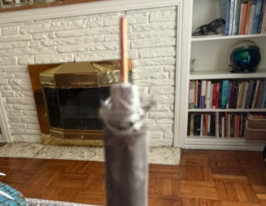
Now, let’s discuss the photograph. What stands out is the exposed copper center conductor and the disturbed shielding immediately below it. We found upwards of seven of these distributed throughout different rooms in the home. Approximately an inch of bare copper extends above the cable jacket. Below that, the metallic shielding appears bunched around the exposed dielectric. There is no F-type connector or 75 ohm termination visible. This is not a properly finished coaxial connection.
More importantly, these weren’t simply unused cables lying disconnected behind wall plates. The branches were connected to an active coaxial distribution system containing numerous splitters. An open ended coaxial connection creates an RF discontinuity. Signals traveling along the cable can reflect back toward the distribution equipment, while exposed conductors and disturbed shielding can allow electromagnetic energy to couple with the surrounding environment.

The center conductor, dielectric, and metallic shield are designed to maintain a consistent electrical relationship. Stripping back the shielding changes that geometry and can affect the cable’s impedance and RF containment. With seven similarly exposed endpoints connected through the active splitter network, there were multiple potential locations for reflections, interference, and signal leakage. Another detail deserves attention. The exposed copper in the photographs is relatively straight and intact rather than frayed or randomly broken. Its appearance is consistent with the cable having been stripped or cut using a tool. The photographs cannot establish why those connections were left unfinished.
What About Nearby Homes? Cable providers frequently serve multiple properties through shared distribution infrastructure. Although residential networks are intended to remain separated, their physical coaxial connections may converge at provider equipment. This becomes particularly relevant when considering MoCA. Without appropriate point of entry filtering, MoCA signals may extend beyond the intended premises. Compatible equipment elsewhere on a physically connected coaxial segment could potentially detect those signals.
If authentication, encryption, and network isolation were also inadequate, unauthorized connectivity could become possible. That doesn’t mean neighboring homes automatically share access to one another’s devices. Physical RF reachability and actual network access are separate issues. But it does raise an important question: where does the residential coaxial network actually end? A properly installed point of entry filter helps contain MoCA signals within the property, while network authentication and encryption provide additional protection.
Could RF Leakage Expose Private Information? This is where the distinction between signal leakage and information leakage becomes important. Specialized RF equipment can measure transmission frequencies, signal strength, timing, and changes in activity. Under certain circumstances, those observations can reveal when communications equipment is operating or how its activity changes over time. Recovering the actual contents of communications is a different matter. Passwords, private messages, audio, and video aren’t automatically exposed because a coaxial cable radiates RF energy. Recovering that information would require a suitable information bearing signal, inadequate encryption, compromised equipment, or another identifiable security weakness.
This distinction is central to TEMPEST and emissions security research. Some unintended electromagnetic emissions can reveal information about electronic activity. Ordinary cable signal leakage, however, does not necessarily provide that capability. For occupants, the most immediate effects of poorly terminated coaxial wiring are generally technical. Internet service may become unreliable, television reception may deteriorate, and communications equipment may experience interference. There may also be no noticeable symptoms.
RF leakage itself cannot ordinarily be seen, heard, or felt. Determining whether emissions exceed applicable exposure limits requires actual measurements. The more significant privacy question is whether the physical cable infrastructure also provides access to a data network.
Where Does the Network End? Homes, businesses, and municipal facilities may share utility corridors, telecommunications providers, or nearby distribution equipment. That doesn’t automatically mean their networks are connected. For communications to pass between separate networks, an actual connection or bridge must exist, along with compatible equipment and insufficient isolation. This is why physical infrastructure mapping matters. A complicated coaxial system with undocumented branches, numerous splitters, and exposed conductors can make it difficult to determine which cable runs are active, where signals travel, and whether the network remains properly isolated.
Most homeowners assume their coaxial wiring is passive infrastructure. Once the internet works and the television turns on, there’s little reason to investigate what happens behind the walls. But coaxial cable carries radio frequency energy, and in many homes it also carries digital network traffic. Improper termination can create RF leakage and interference. Inadequate isolation can introduce cybersecurity vulnerabilities. Undocumented cable branches can make both problems harder to recognize. The important questions aren’t limited to whether a cable outlet works. They’re where the wiring connects, what signals it carries, whether those signals remain contained, and who or what can communicate across the network.
For those interested in further exploring the relationship between signals intelligence, electromagnetic emissions, telecommunications interception, and RF leakage, several documented programs and investigations offer compelling research, including NSA TEMPEST, ECHELON and microwave interception, NSA Upstream Collection involving telecommunications infrastructure, Operation SHAMROCK, and FCC cable signal leakage investigations.
Discover more from Solide Info | The Engineer’s Authority on Cyber Defense
Subscribe to get the latest posts sent to your email.