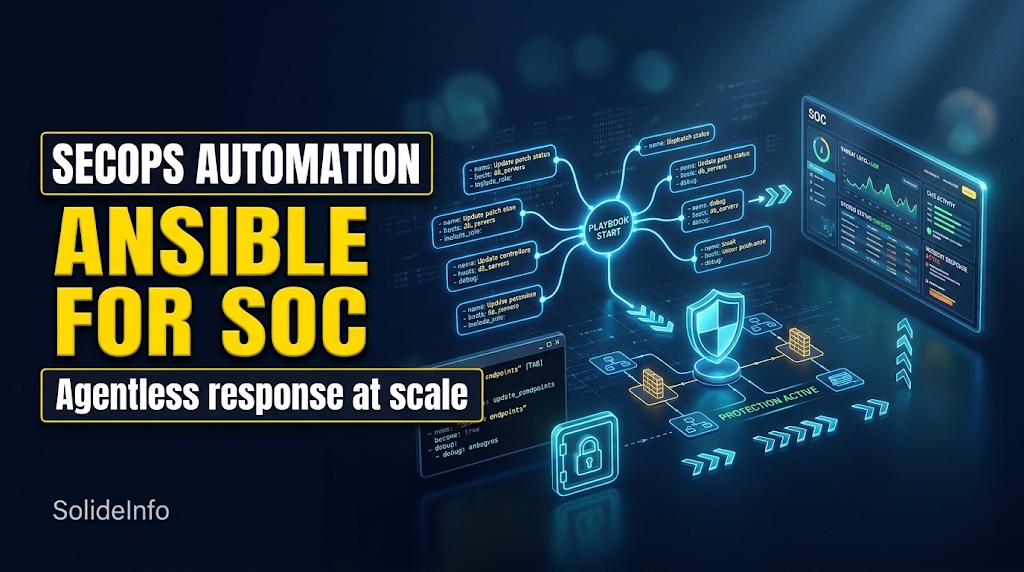
Ansible for SOC engineer teams solves a structural problem: detection coverage scales with telemetry, but containment still depends on human hands. A SIEM can correlate ten thousand events per hour, yet the same analyst who triages an alert is often the one who must log into a firewall, a directory controller, and an endpoint console to act on it. Ansible closes that gap without installing an agent on every endpoint or asking analysts to become software developers.
This pillar article examines where Ansible fits in a security operations center, where it does not, and how to build playbooks and roles that survive an audit. The framing is engineer-to-engineer: no vendor advocacy, no purchase guidance, and no assumption that automation replaces judgment. Ansible playbooks are most useful when they encode decisions that have already been approved—not when they improvise.
Executive Summary
- Ansible is a delivery mechanism, not a detection engine. It executes approved actions across firewalls, endpoints, identity systems, and cloud APIs from a single control node. It does not replace SIEM correlation or SOAR orchestration logic; it often sits underneath both.
- Agentless architecture is the operational advantage. No software is installed on managed nodes, so SOC automation can reach network devices, appliances, and legacy systems that resist agent deployment.
- Idempotence is a safety property, not a convenience. Re-running a containment playbook should converge the target to the desired state—not repeat destructive actions. This is what makes Ansible safe to invoke mid-incident.
- The hard problems are governance problems. Secret handling, approval gates, RBAC, and rollback design matter more than YAML syntax. A SOC automation program without those controls is a liability with a version history.
Where Ansible Fits in the SOC Automation Stack
SOC automation is not a single product category. It is a layered set of capabilities: detection, enrichment, decisioning, and action. Ansible is strongest in the action layer and increasingly capable in the enrichment layer through API interactions. Understanding the boundaries prevents tooling overlap and dashed expectations.
The distinction between SOAR and Ansible
SOAR platforms orchestrate security tools into workflows. They ingest alerts from a SIEM, enrich indicators, apply decision logic, and dispatch actions across integrated products through APIs. Ansible is a configuration management and automation engine that executes tasks on hosts and through APIs. It has no native alert queue, no case management, and no built-in analyst interface.
The two are complementary. A SOAR platform may call an Ansible playbook as one step in a larger incident workflow—for example, after enrichment confirms a compromised host, SOAR hands off to Ansible for containment because Ansible can reach the host directly and enforce state. Conversely, Ansible can trigger a SOAR webhook through the ansible.builtin.uri module when a playbook completes.
The practical rule: use SOAR for alert-centric orchestration and analyst workflow; use Ansible for host-centric and device-centric enforcement. Neither replaces the other, and claiming otherwise leads to brittle designs.
The agentless advantage for heterogeneous SOC estates
Security estates are rarely uniform. A SOC may need to act on Linux servers, Windows endpoints, network firewalls, load balancers, storage arrays, and cloud control planes. Agent-based automation requires deploying and maintaining software on each class of system—which is often impossible for appliances and frequently undesirable for production servers under change control.
Ansible connects over SSH for Linux and network devices, and over WinRM or PowerShell remoting for Windows. No persistent agent is required on the managed node. That reduces the operational footprint of the automation platform itself and removes a class of “automation agent” vulnerabilities from the attack surface.
Event-Driven Ansible and the reactive boundary
Ansible has moved beyond scheduled runs. Event-Driven Ansible (EDA) listens for events from monitoring tools, evaluates conditions in rulebooks, and triggers playbooks in response. A rulebook can define that when failed SSH login counts exceed a threshold, a playbook blocks the source IP at the firewall, notifies the security team, and collects logs for forensic analysis.
This is not a replacement for SIEM correlation. EDA is a reaction layer—it executes the “then” after a trusted source asserts the “if.” The quality of the automation depends entirely on the quality of the event source. Bad telemetry produces bad containment, faster.

Figure 1: Event-to-containment workflow using Event-Driven Ansible with a verification gate before the audit record is closed.
Building Playbooks and Roles That Survive an Audit
The difference between a lab playbook and a production SOC playbook is not complexity. It is traceability. Every task that touches a production system must be attributable to an approved change, run under a known identity, and leave a record that an auditor can follow.
Playbook structure for containment actions
A containment playbook should be boring. It should do one thing, expose a clear set of variables, support a check mode, and fail loudly rather than partially. The following example blocks a source IP at the host firewall and is designed to be re-run safely—if the rule already exists, the module reports no change.
yaml
---
- name: Block confirmed malicious source at host firewall
  hosts: hardened_linux
  become: true
  vars:
    block_ip: "198.51.100.42"
    block_comment: "SOC-CASE-<REDACTED>"
  tasks:
    - name: Reject inbound traffic from confirmed indicator
      ansible.builtin.iptables:
        chain: INPUT
        source: "{{ block_ip }}"
        jump: DROP
        comment: "{{ block_comment }}"
        state: present
      register: fw_result

    - name: Log the enforcement action for audit
      ansible.builtin.lineinfile:
        path: /var/log/soc-automation.log
        line: "{{ ansible_date_time.iso8601 }} blocked {{ block_ip }} case={{ block_comment }} changed={{ fw_result.changed }}"
        create: true
        mode: '0640'
The iptables module enforces the rule and state: present makes the task idempotent. The register captures whether the system actually changed, which feeds the audit line. The comment field ties the rule to a case identifier—not a real one in this example, and never a live credential or internal hostname. Verify module parameters against the official documentation for your Ansible version.
Prerequisites: this playbook assumes become: true is permitted by the target’s sudo policy and that the control node’s SSH key is stored in a vault, not in the repository. The risk is blunt: a typo in block_ip can drop legitimate traffic. Run in --check mode first, and gate production execution behind an approval in AWX or the automation controller.
Roles, not monoliths
A role packages tasks, handlers, defaults, and templates into a reusable unit. For SOC automation, roles should map to operational capabilities—not to individual incidents. A soc_firewall_containment role can be called from a manual playbook, an EDA rulebook, or a SOAR webhook without rewriting the logic each time.
Role design rules that reduce incident-time friction:
- Defaults must be safe. A role should default to check mode or a no-op unless an explicit
enforce: truevariable is set. - Handlers must be idempotent. Restarting
auditdorrsyslogtwice should not corrupt state. - Every role should emit structured output. Register a result dictionary with
changed,failed, and a sanitized summary so downstream systems can parse it. - No secrets in defaults, vars, or templates. Use vault references or a secret manager lookup, and set
no_log: trueon tasks that touch credentials.
Hardening roles and compliance evidence
Ansible-Lockdown provides roles that apply CIS Benchmarks and DISA STIGs to Linux systems, and the same pattern can generate audit evidence. A compliance role should do two things: enforce the baseline and report the post-change state as facts that can be exported to a governance system.
A minimal compliance role task sequence:
- Apply the benchmark role with a pinned version.
- Run a read-only audit pass after remediation.
- Write a JSON report to a controlled path.
- Fail the play if any control remains non-compliant, or route the exception to a ticketing system.
This is not a substitute for a SCAP scanner. It is an enforcement and evidence pipeline that reduces the gap between “the benchmark says X” and “the system is actually at X.” Mapping controls to NIST CSF or ISO 27001 clauses is a documentation exercise, not a technical one—the role enforces configuration, while the control mapping lives in the governance layer.

Figure 2: Component view of an Ansible control node crossing trust boundaries into endpoint, network, and identity planes, with all enforcement outcomes routed to an evidence store.
Event-Driven Response and Operational Guardrails
Automated containment is only defensible when the guardrails are visible to the people who inherit the consequences. A SOC engineer who deploys an EDA rulebook is not just writing YAML—they are defining what the organization will do, automatically, at machine speed.
EDA rulebook design for SOC use cases
EDA rulebooks are structured as sources, rules, and actions. A security rulebook should always include a verification step before declaring success. Blocking an IP at a firewall is an action; confirming that the block is effective is the outcome that matters.
A rulebook pattern for brute-force containment:
- Source: SIEM webhook or syslog event stream.
- Condition: failed login count exceeds threshold within a time window.
- Action: run a containment playbook that blocks the source, notifies the on-call analyst, and creates a case note.
- Verification: run a read-only playbook that checks the firewall rule count and returns the result to the case.
EDA supports enterprise firewalls, IDPS, SIEM, PAM, EPP, threat detection, and phishing mitigation as security use cases. The common failure mode is skipping the verification task. An automated block that silently fails is worse than no block, because it creates false assurance.
Secret handling and least privilege
The single most common audit finding in SOC automation is credential sprawl. API tokens for firewalls and SIEMs get pasted into playbooks, committed to Git, and shared over chat. The fix is not a policy document—it is a technical control.
Non-negotiable practices:
- Ansible Vault for at-rest encryption. Encrypt variable files and vault password retrieval through a client script backed by a secret manager, not a plaintext file on the control node.
no_log: trueon every task that touches a secret. This masks output in logs, with the caveat that some debug modes can still expose data—so do not rely on it as the only control.- Short-lived credentials where the target supports them. API tokens with rotation schedules, not permanent keys.
- RBAC on the automation controller. Analysts who can run a containment playbook should not necessarily be able to edit it. Separate “run” permission from “edit” permission.
AWX provides the upstream open-source controller with job scheduling, a web UI, and a REST API. It is suitable for lab and evaluation work, but it is not a supported production product: AWX does not receive security fixes for prior releases, its upgrades are not tested across multiple versions, and its images are not signed or security-hardened. The commercially supported automation controller is the production path when audit and support requirements apply. This is a capability and lifecycle statement, not a purchase recommendation—organizations should evaluate it against their own support and compliance posture.
Dry-run, approval gates, and rollback
Every containment action should be executable in three modes: check, approve, and enforce. Ansible’s --check mode previews changes without applying them, but not every module supports check mode fully. A safer pattern is to build a dedicated read-only verification playbook alongside every enforcement playbook.
Approval gates belong in the automation controller, not in a chat message. A workflow can require an approver from the SOC lead role before a production containment job runs. The approval is logged, the approver is identifiable, and the job output is retained.
Rollback is the most neglected design element. For firewall blocks, rollback means removing the rule with state: absent. For endpoint isolation, it means restoring network access only after a case review. A rollback playbook should be versioned alongside the enforcement playbook and tested in the same pipeline.
Logging and evidence integrity
Automation logs are evidence. If a containment action is challenged, the organization needs to show who approved it, what ran, what changed, and when. The automation controller’s job log is a starting point, but it should not be the only record. Forward job events to the SIEM and retain the playbook version hash alongside the case identifier.
The NVISO work on SIEM log collector management makes the stakes explicit: inconsistent collector configurations create detection gaps and undermine evidence integrity, and Ansible plus version control restores traceability. The same principle applies to containment. An unversioned playbook is an unverifiable action.

Figure 3: Automation lifecycle from authoring through peer review, CI validation, approval-gated enforcement, verification, and periodic role review.
Advanced FAQ
How does Ansible for SOC engineer workflows handle Windows endpoints without an agent?
Ansible connects to Windows hosts over WinRM or PowerShell remoting using the ansible.windows collection. No persistent agent is installed. The control node needs valid credentials and network reachability on the WinRM port, and the target must have WinRM configured and a certificate or trusted authentication method in place. For containment, modules such as ansible.windows.win_firewall_rule can block traffic at the host firewall, and win_shell can invoke native security tools. Test connectivity with ansible.windows.win_ping before relying on Windows automation in an incident.
What is the difference between an Ansible playbook and an Ansible role in a SOC context?
A playbook is a YAML file that maps tasks to hosts. A role is a reusable, structured bundle of tasks, handlers, defaults, and templates that can be called from multiple playbooks. In a SOC, a playbook is often incident-specific—”block this indicator on these hosts.” A role is capability-specific—”contain a host at the firewall.” Roles are what you version, test, and approve; playbooks are what you invoke at 2 a.m. Mixing the two creates duplication and audit gaps.
Can Event-Driven Ansible replace a SOAR platform?
No. EDA is a reaction framework that listens for events and triggers playbooks based on rulebook conditions. It has no case management, no analyst queue, no alert deduplication, and no native enrichment orchestration. A SOAR platform manages the incident lifecycle and may call Ansible as an action step. EDA is best understood as the fastest path from a trusted event to an enforceable action, not as a replacement for the workflow layer around it.
How should secrets be managed when a playbook needs firewall API credentials?
Store the credential in a secret manager and retrieve it at runtime, or encrypt it with Ansible Vault and decrypt using a vault password client script backed by the same secret manager. Never place the credential in a playbook, a role default, an inventory file, or a CI variable in plaintext. Set no_log: true on the task that authenticates, restrict who can view job output, and rotate the credential on a defined schedule. If the credential grants write access to a production firewall, treat it as a privileged account and apply the same controls as a domain admin password.
What is the minimum viable governance model for SOC automation?
Four controls: (1) all playbooks and roles in version control with peer review; (2) an automation controller with role-based access control separating run from edit; (3) an approval gate for any action that changes production state; (4) a retained audit trail that links each job to a case identifier and a playbook version. Without these four, automation accelerates action without improving accountability, which is the opposite of a security control.
Does Ansible support check mode for every containment module?
No. Check mode support varies by module and by the underlying system. The iptables module supports check mode for many operations, but modules that call external APIs may not accurately predict state changes. Build a separate read-only verification playbook for any containment action where check mode is unreliable. Treat check mode as a preview, not a guarantee, and never substitute it for post-change verification.
Ansible for SOC engineer operations is not a platform decision. It is a discipline decision: encode approved actions in versioned, idempotent roles; execute them through an authenticated, logged, approval-gated controller; and verify the outcome before declaring the incident contained. The tooling is agentless, cross-platform, and readable by analysts who are not developers—but none of those properties matter without governance.
For teams starting out, the sequence that reduces risk fastest is: begin with read-only enrichment playbooks, move to check-mode hardening roles, then introduce a single containment playbook behind an approval gate. Measure mean time to contain before and after. If the number does not improve, the bottleneck is not automation coverage—it is decision latency, and that is a process problem, not a YAML problem. The organizations that get this right treat Ansible for SOC engineer workflows as an extension of change management, not as a shortcut around it.
Discover more from Solide Info | The Engineer’s Authority on Cyber Defense
Subscribe to get the latest posts sent to your email.