
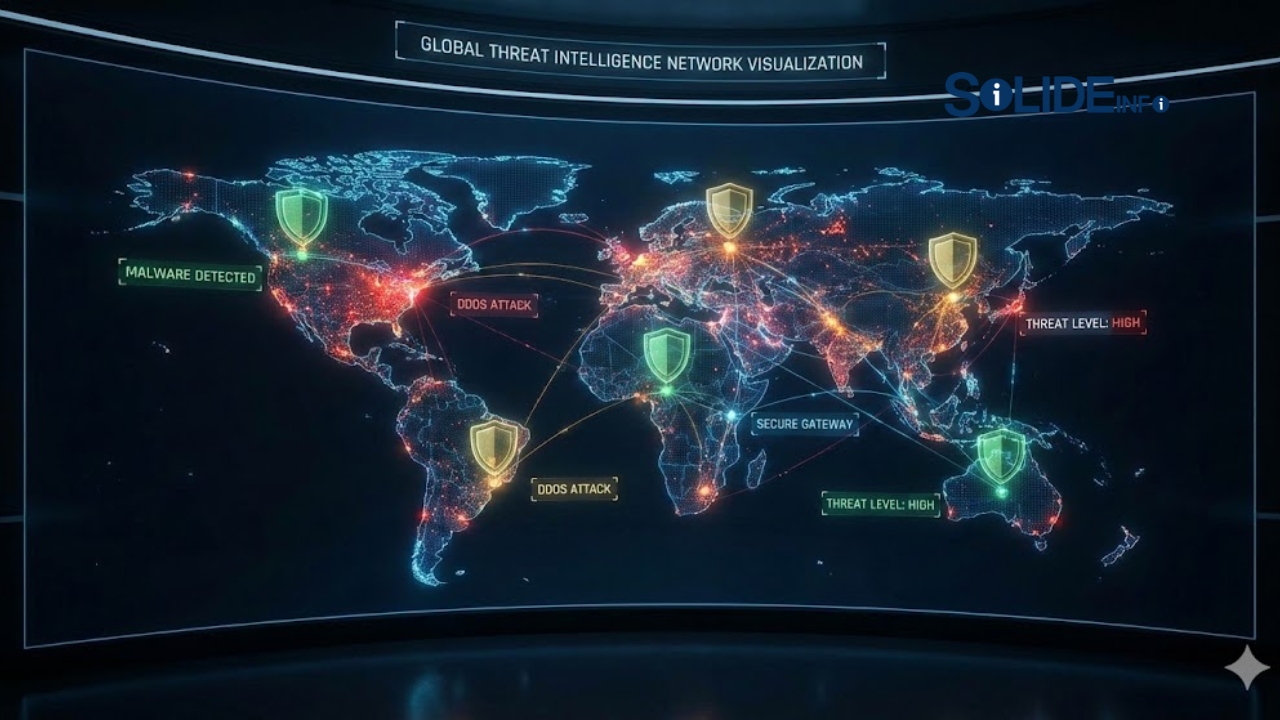
Cyberattacks are no longer a question of “if,” but “when.” In today’s hyper-connected digital landscape, threat intelligence is the only barrier standing between your sensitive data and a catastrophic breach.
For security professionals and business leaders alike, the sheer volume of data can be overwhelming. You know you need to be proactive, but where do you start? How do you distinguish between noise and a genuine signal of an impending attack?
This comprehensive guide is designed for decision-makers and defenders. You will learn how to leverage intelligence to anticipate attacks, understand the tools available, and build a fortress around your digital assets.
1. Defining Cyber Threat Intelligence and Its Importance

Cyber threat intelligence (CTI) is the process of collecting, processing, and analyzing data to understand a threat actor’s motives, targets, and attack behaviors. It is not merely data; it is data enriched with context that allows you to make informed decisions.
Cyber security threat intelligence transforms raw information into actionable defense mechanisms. Without it, security teams are flying blind, reacting to incidents only after the damage is done.
The Three Pillars of CTI
To fully grasp the concept, we must break it down into three distinct levels:
- Strategic Intelligence: This is high-level information reserved for non-technical audiences like the board of directors. It covers the “who” and the “why,” focusing on financial impact and broad trends.
- Operational Intelligence: This targets middle management and focuses on the “how” and “where.” It involves studying the specific campaigns of hacker groups.
- Tactical Intelligence: This is for the “in the trenches” security analysts. It deals with technical indicators of compromise (IOCs) like bad IP addresses, file hashes, and malicious domains.
Why It Matters Now
The modern attack surface is massive. Cloud computing, remote work, and IoT devices have created infinite entry points. CTI narrows your focus.
Instead of trying to patch every vulnerability at once, intelligence tells you which vulnerabilities are actually being exploited in the wild right now. It moves you from a reactive posture to a proactive defense.
Key Takeaway: Intelligence is the difference between blindly fighting fires and fireproofing your building before the arsonist arrives.
2. The Role of Source Intelligence in Data Collection
Source intelligence acts as the raw fuel that powers the entire analysis engine. Without diverse and reliable sources, your analytical models are just empty shells.
Sourced intelligence comes from a variety of origins, and understanding the distinction between them is critical for vetting the accuracy of your data.
Types of Intelligence Sources
In the professional intelligence community, we categorize data collection methods using specific “INTs”:
- HUMINT (Human Intelligence): Information gathered from human sources. In cyber, this might be a researcher infiltrating a dark web forum to chat with hackers.
- SIGINT (Signals Intelligence): Interception of signals, often used by governments to monitor communications.
- OSINT (Open Source Intelligence): Data available to the public. This is the bread and butter of most private sector CTI.
- TECHINT (Technical Intelligence): Analysis of weapon systems or, in our case, malware reverse engineering.
The Validation Challenge
The biggest challenge with sourced intelligence is validation. Not every alert is real.
False positives can cause “alert fatigue,” where your security team stops paying attention to warnings because the last fifty were duds.
Effective sourcing requires a mix of automated feeds and human verification. You cannot rely on a single source. You must cross-reference data points to confirm their validity before taking action.
3. Understanding the APT Threat Landscape
An APT threat represents the pinnacle of cyber adversaries, usually state-sponsored or highly organized criminal syndicates.
Advanced persistent threats differ from standard “smash and grab” hackers because they play the long game. Their goal is not just to break in, steal, and leave; their goal is to remain undetected in your network for months or even years.
An APT attack is characterized by stealth, significant resources, and specific objectives, such as corporate espionage or political sabotage.
Characteristics of an APT
- Funding: These groups often have government backing or massive criminal revenues.
- Custom Tooling: They do not just use off-the-shelf malware; they write custom code (“Zero-Days”) to bypass standard antivirus.
- Persistence: If you block one entry point, they have three backdoors already installed.
The APT Kill Chain
To stop an APT threat, you must understand their lifecycle, often referred to as the Cyber Kill Chain:
- Reconnaissance: They study your employees on LinkedIn and scan your network.
- Weaponization: They create a specific malware payload for your vulnerabilities.
- Delivery: Phishing emails or water-holing attacks.
- Exploitation: The code runs on your system.
- Installation: They install a backdoor.
- Command and Control (C2): They take remote control of the system.
- Actions on Objectives: They steal data or destroy systems.
Download Our APT Defense Checklist
4. Navigating the OSINT Framework for Investigation
The OSINT framework is a legendary resource in the cybersecurity community that categorizes the vast amount of free tools and resources available for intelligence gathering.
The open source intelligence framework essentially provides a treasure map for analysts looking to find information on targets without touching their systems directly.
How the Framework operates
The framework is organized by data types. If you are looking for information on a specific email address, the framework guides you to tools that can:
- Check if the email was involved in a breach.
- Find social media accounts linked to it.
- Locate domain registrations associated with it.
Practical Application
Imagine you see a suspicious IP address hitting your firewall. Using the OSINT framework logic, you wouldn’t just block it. You would:
- Geolocation: Find out which country the IP is from.
- Reputation Check: See if other analysts have reported it.
- Passive DNS: See what websites have been hosted on that IP in the past.
This context tells you if it’s a random bot or a targeted attack from a known hostile nation.
Note: While the framework is powerful, always ensure your investigations remain legal. Active scanning of infrastructure you do not own can be illegal in many jurisdictions.
5. Applying the MITRE ATT&CK Framework

The MITRE ATT&CK framework is the global standard for documenting and understanding adversary behaviors.
Unlike the Kill Chain, which is linear, the MITRE ATT&CK framework is a matrix that describes the specific Tactics, Techniques, and Procedures (TTPs) hackers use.
The Matrix Structure
- Tactics: The “Why.” (e.g., Initial Access, Execution, Persistence).
- Techniques: The “How.” (e.g., Phishing, PowerShell, Scheduled Task).
- Procedures: The specific implementation details used by a group.
Mapping Defense to Offense
Security Operations Centers (SOCs) use MITRE to map their defenses.
If you know that a specific ransomware group uses “Spearphishing Link” (T1566.002) for entry and “PowerShell” (T1059.001) for execution, you can check your security tools.
- Do we have email filtering?
- Do we monitor PowerShell logs?
If the answer is no, you have a “coverage gap.” MITRE helps you visualize these gaps instantly.
6. Managing Common Vulnerabilities and Exposures (CVEs)
Common vulnerabilities and exposures are the open doors in your software that hackers walk through.
Common vulnerabilities and exposures cves are cataloged in a public list maintained by the MITRE Corporation, providing a standardized way to identify and fix security flaws.
The Lifecycle of a CVE
- Discovery: A researcher (or hacker) finds a bug in software like Windows or Chrome.
- Assignment: A CVE ID (e.g., CVE-2024-1234) is assigned.
- Scoring: The vulnerability is given a CVSS score from 0.0 to 10.0 based on severity.
- Patching: The vendor releases a fix.
Prioritization is Key
You cannot patch everything. Large enterprises have millions of vulnerabilities.
Threat intelligence helps here. It tells you which common vulnerabilities and exposures are actually being used by APT threats.
If CVE-A has a score of 9.0 but is hard to exploit, and CVE-B has a score of 7.0 but is being used by ransomware gangs right now, you patch CVE-B first.
7. Essential Open Source Intelligence Tools
Open source intelligence tools are vital for gathering data without spending a fortune on enterprise licenses.
There are hundreds of open source intelligence tools available, but a few stand out as industry standards for any threat intelligence analyst.
Top Tool Comparison
| Tool Name | Primary Function | Best Use Case | Cost |
| Maltego | Link Analysis | Visualizing relationships between people, domains, and IPs. | Freemium |
| Shodan | IoT Search Engine | Finding exposed servers, webcams, and SCADA systems. | Freemium |
| TheHarvester | Email/Domain Scraping | Gathering emails and subdomains for a specific target. | Free |
| VirusTotal | Malware Analysis | Checking if a file or URL is malicious against 70+ scanners. | Free |
A Note on Visuals
Sometimes, intelligence gathering leads to unexpected places. You might be analyzing metadata in an image and find something as random as a Gemini banana image hidden in the steganography. Tools like StegSolve are crucial for digging into these visual anomalies.
Spotlight: TheHarvester
This is a favorite for reconnaissance. It scrapes search engines like Google and Bing to find every email address associated with a company domain.
If you run TheHarvester on your own company and find 500 emails exposed, that is 500 potential targets for phishing that you need to protect.
Compare Professional OSINT Tools Pricing Here
8. Commercial vs. Open Source: Making the Choice
When building your stack, you will face a choice: pay for curated feeds or build your own using open source.
Commercial Feeds
- Pros: Curated, low false positives, high-speed delivery, support included.
- Cons: Expensive, can be a “black box” regarding sources.
- Best For: Enterprise teams with budget but limited time.
Open Source (OSINT)
- Pros: Free, transparent, massive community support.
- Cons: High noise-to-signal ratio, requires manual validation, no customer support.
- Best For: Researchers, small businesses, and augmenting commercial feeds.
The Hybrid Approach
Most mature organizations use a hybrid model. They subscribe to one or two high-fidelity commercial feeds (like Mandiant or Recorded Future) and enrich that data using open source intelligence tools. This provides the best of both worlds: reliability and breadth.
9. Step-by-Step Guide to Building a Threat Intel Program
Starting a program from scratch? Follow these steps to ensure you build a capability that adds value, rather than just noise.
Step 1: Define Your Requirements
Do not just collect data. Ask yourself:
- What assets are we protecting?
- Who are our likely adversaries?
- What decisions do we need to make?
Step 2: Select Your Sources
Combine sourced intelligence feeds. Start with free feeds (like CISA or FBI alerts) and add paid ones as you mature.
Step 3: Choose a Platform (TIP)
You need a Threat Intelligence Platform (TIP) to aggregate the data. MISP (Malware Information Sharing Platform) is a fantastic free option to start with.
Step 4: Analyze and Triage
When an alert comes in, investigate it.
- Is it relevant to our tech stack?
- Have we seen it before?
- Is it actionable?
Step 5: Disseminate
Send the right info to the right people.
- Patching Team: Send CVEs.
- Firewall Team: Send malicious IPs.
- C-Suite: Send executive summaries of industry trends.
10. Pros and Cons of a Threat Intelligence Program

Before investing heavily, weigh the benefits against the operational costs.
Pros
- Proactive Defense: You stop attacks before they happen.
- Faster Response: When a breach occurs, you know exactly what to look for.
- Better Communication: You can explain risks to the Board in business terms.
- Resource Optimization: You stop wasting time on irrelevant alerts.
Cons
- Cost: Quality feeds and analysts are expensive.
- Complexity: Integrating intelligence into existing tools can be difficult.
- Information Overload: Without good filtering, you will drown in data.
- False Positives: Acting on bad data can disrupt business operations.
11. Frequently Asked Questions (FAQs)
What is the difference between Threat Intelligence and Threat Hunting?
Threat Intelligence is the data (the map). Threat Hunting is the activity (walking the terrain). Intelligence tells you what to look for; hunting is the act of actively searching your network for those indicators.
Is OSINT legal?
Generally, yes. OSINT framework tools use publicly available data. However, how you use that data matters. passive gathering is legal; using that data to hack back is illegal.
Can small businesses afford Threat Intelligence?
Absolutely. By utilizing open source intelligence tools and free feeds from government agencies (like CISA in the US or NCSC in the UK), small businesses can build a robust defense without spending zero dollars on data feeds.
How often should intelligence be updated?
Ideally, in real-time. APT threats change their infrastructure daily. A feed that is a week old is often useless.
12. Final Thoughts and Recommendations
In the rapidly evolving world of cybersecurity, ignorance is not bliss—it is a liability.
By integrating threat intelligence into your security strategy, you move from a posture of fear to one of confidence. whether you are tracking a sophisticated APT threat or simply patching common vulnerabilities and exposures, the principles remain the same: knowledge is power.
Your Action Plan
- Audit your current visibility: Do you know what is hitting your firewall?
- Explore the OSINT Framework: Spend time familiarizing yourself with the free tools available.
- Start Small: Pick one high-priority threat (like Ransomware) and focus your intelligence gathering there.
Do not wait for the breach to happen. Start building your intelligence capability today and secure your digital future.
Start Your Free Trial of Our Recommended Threat Intel Platform